By Ed Drost — Maryland State Certified Residential Appraiser, License #30004874. Serving Baltimore City, Baltimore County, Carroll County, and Harford County for 36 years.
There's a specific kind of quiet that falls over a deal when the appraisal comes back below the contract price. The buyer's excited, the seller's already mentally spent the money, and then a number lands that's five, ten, sometimes twenty thousand dollars short — and everyone looks at each other wondering who's about to lose the house or the sale.
I've been on the other end of that phone call for 36 years. So let me tell you what a low appraisal actually means in a Baltimore transaction, what your real options are, and how the reconsideration-of-value process works now that the rules changed in 2024 — because most of the advice floating around online is either out of date or written by people who've never signed an appraisal report.
If you haven't read it yet, my companion piece on how to budget for your Baltimore appraisal covers the cost and timing side. This one covers what happens when the number itself is the problem.
What a "low" appraisal really means
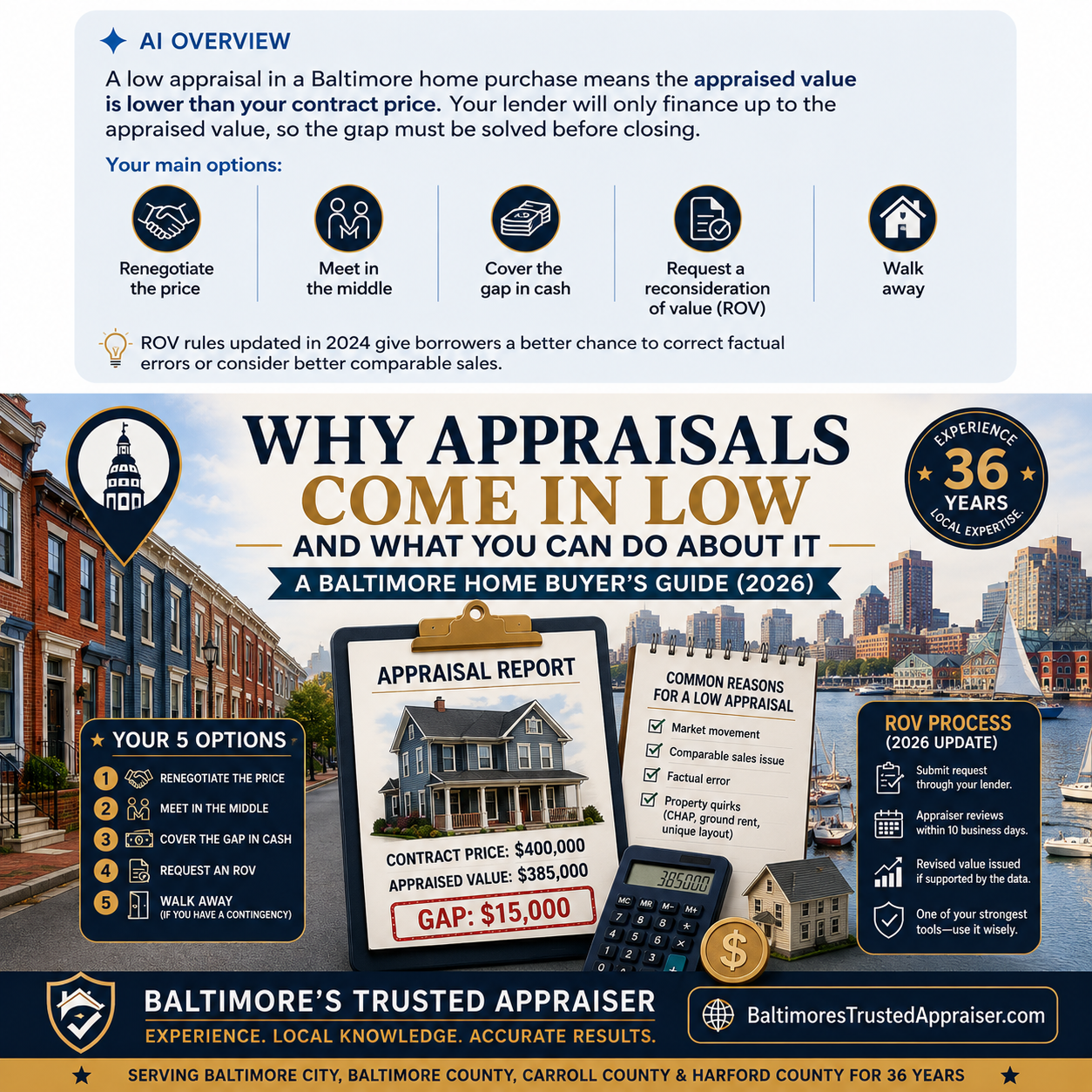
A low appraisal simply means the appraiser's opinion of the home's fair market value came in below the agreed contract price. It matters because your lender will only lend against the appraised value, not the price you agreed to pay. If a Baltimore home is under contract at $400,000 and it appraises at $385,000, the lender bases your loan on $385,000 — and the $15,000 gap becomes something the buyer, the seller, or both have to solve before the deal can close.
That's the whole mechanism. The appraisal isn't a personal judgment on the house or on you. It's the lender protecting itself from lending more than the collateral is worth, and it's the reason a certified, independent valuation exists in the first place.
First, understand why it came in low
Before you react, find out the reason — because the reason determines which option actually helps you. In my experience, a low Baltimore appraisal usually traces to one of a few things.
Sometimes the market genuinely moved, and the contract price ran ahead of what comparable sales support — common when a bidding war pushes a price past the neighborhood's recent sales. Sometimes it's a comparable-sales issue: the appraiser used sales that don't reflect the subject property well, or better comps existed that weren't in the file. Occasionally there's a factual error — square footage miscounted, a finished basement or a recent renovation missed, the wrong bed-and-bath count. And in Baltimore specifically, property quirks like ground rent, a CHAP historic designation, or an unusual rowhouse configuration can trip up an appraiser who doesn't work these neighborhoods regularly.
The first three of those are fixable through a formal process. The first one — the market simply doesn't support the price — usually isn't, and no amount of appealing changes it. Knowing which situation you're in saves you from wasting the one real shot you get.
Your options when the value comes in low
Once you know the reason, you have five realistic paths. Most deals get solved with one of them.
Renegotiate the price. The cleanest fix. If the home appraised at $385,000, the seller may agree to lower the price to meet it, especially in a slower market where they don't want to start over. The appraisal becomes your leverage — it's an independent professional saying the home is worth what you'd be offering.
Meet in the middle. Buyer and seller split the gap. The seller drops the price part way, the buyer brings a little extra cash, and the deal survives. In Baltimore's current market I see this compromise land deals more often than any single-sided concession.
Cover the gap in cash. If you have the funds and you want the house, you can pay the difference between the appraised value and the price out of pocket, on top of your down payment. Only worth it if you're confident in the home's long-term value, since you're paying above what an independent appraiser says it's worth today.
Request a reconsideration of value. If you believe the appraisal contains a factual error or overlooked better comparable sales, you can ask your lender to submit a reconsideration of value — an ROV. This is the option most people don't understand, so I've broken it out in detail below.
Walk away. If your contract has an appraisal contingency, a low appraisal typically lets the buyer exit and recover the earnest money deposit. Nobody wants this outcome, but a contingency exists precisely so you're not forced to overpay for a home that didn't appraise.
How a reconsideration of value (ROV) works in 2026
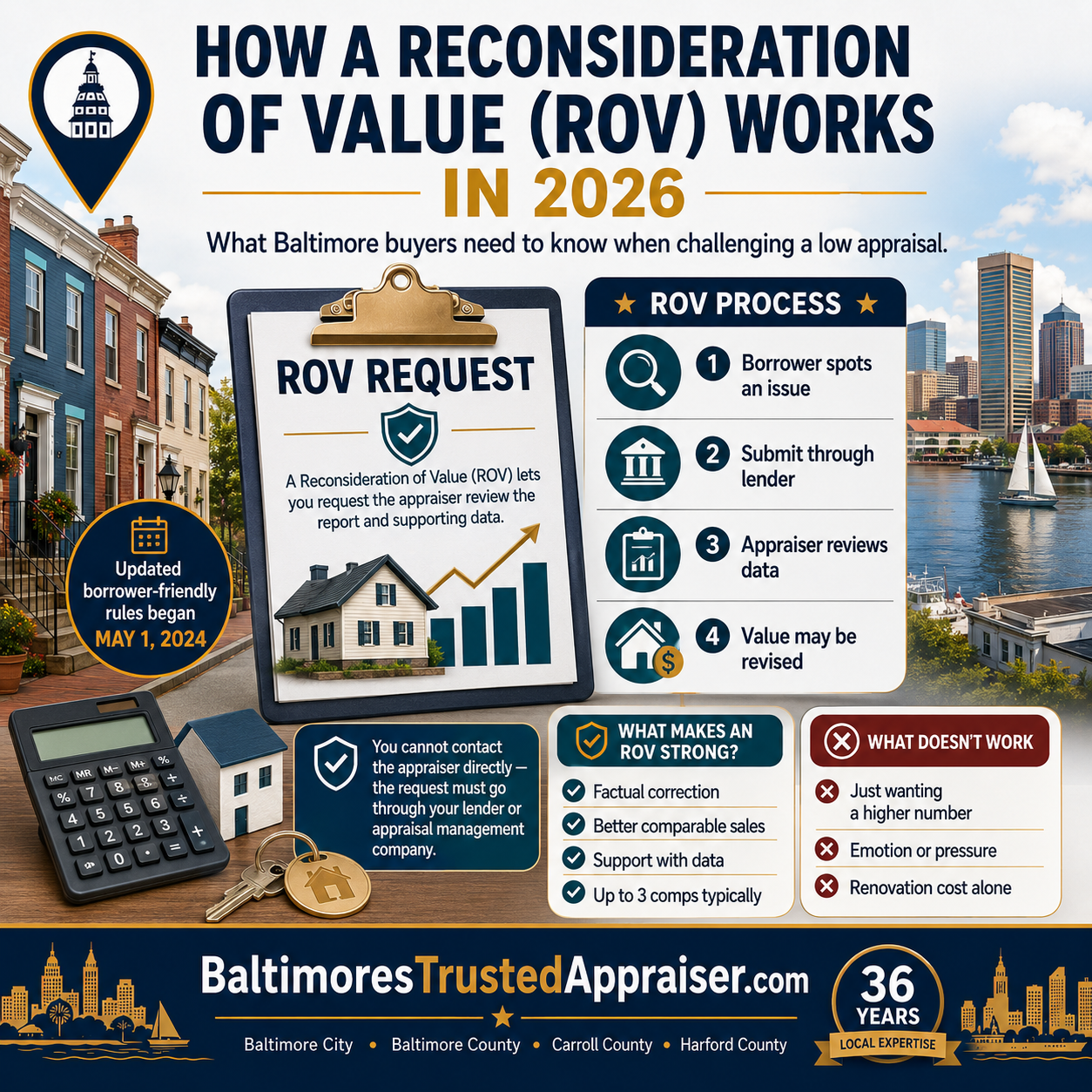
The reconsideration-of-value process changed meaningfully in 2024, and it's worth understanding the current version, because the rules are more borrower-friendly than they used to be.
An ROV is a formal request asking the appraiser to review the original report in light of information that wasn't in it — a factual correction, or comparable sales that appear more suitable than the ones used. On May 1, 2024, Fannie Mae, Freddie Mac, and HUD rolled out standardized requirements so that every borrower has a clear, consistent way to request one. Before that, each lender ran its own process, and many buyers never knew the option existed.
Here's how it actually works, and the parts people get wrong:
You go through your lender — always. You cannot call the appraiser directly. The request has to be routed through your lender or their appraisal management company. An appraiser who takes editing instructions straight from a buyer or agent has compromised their independence, and any honest appraiser will decline that conversation.
It has to be built on data, not disappointment. This is the single biggest reason ROVs fail. Needing a higher number to make your deal work is not a valid basis for a reconsideration. What works is evidence: specific comparable sales the appraiser didn't use that genuinely fit the property better, or a documented factual error like miscounted square footage. You can typically submit up to three additional comparable sales for consideration.
Improvements don't equal their cost. Buyers often assume a $40,000 kitchen remodel adds $40,000 to the appraised value. It rarely does. Appraisers value a home based on what buyers in that market will actually pay, so a renovation might add far less than it cost. Basing an ROV on "but we spent X" without market support won't move the number.
The appraiser isn't required to change anything. They'll review the evidence and either amend the report or explain why the original value stands. A reconsideration is a genuine second look, not an automatic revision — and a defensible appraisal often survives one, which is exactly how the system is supposed to work.
Why this is where a local appraiser earns their fee
Here's the honest part most articles won't tell you: a well-supported appraisal from someone who knows Baltimore is the best protection against this whole scenario in the first place. Many low appraisals I get asked to review as a second opinion trace back to an out-of-area appraiser who didn't account for a neighborhood's nuances — who treated a Federal Hill rowhouse like any other three-bedroom, or missed how ground rent or a historic designation plays into value here.
For lender purchases, you generally don't get to choose the appraiser; the lender orders it through their management company. But for the situations where you do control it — a divorce valuation, an estate settlement, a property-tax appeal, or a pre-listing appraisal to price your home right before it ever goes under contract — hiring a certified appraiser who works these specific Baltimore neighborhoods every week is the difference between a number that holds up and one you end up fighting.
Low Appraisal in Baltimore — Common Questions
What happens if my Baltimore home appraises for less than the offer? Your lender will base the loan on the lower appraised value, not the contract price, which creates a gap someone has to cover. You generally have five options: renegotiate the price down, split the difference with the seller, pay the gap in cash, request a reconsideration of value through your lender if there's a factual error or better comparable sales, or exit under an appraisal contingency and recover your earnest money.
Can I dispute a low appraisal in Maryland? Yes, through a reconsideration of value (ROV). You submit the request to your lender — never directly to the appraiser — with supporting evidence such as comparable sales that were overlooked or a documented factual error like incorrect square footage. Since May 2024, Fannie Mae, Freddie Mac, and HUD require lenders to offer a standardized ROV process to every borrower. The appraiser reviews the evidence but is not required to change the value.
Does a renovation guarantee a higher appraisal value? No. Appraisers value a home by what the local market will pay, not by what improvements cost. A $40,000 remodel may add considerably less than $40,000 to the appraised value, so a reconsideration of value based only on renovation spending, without comparable-sales support, usually won't succeed.
Who can request a reconsideration of value? The borrower initiates it, but the request must be routed through the lender or their appraisal management company, which then forwards it to the appraiser. A buyer or real estate agent cannot contact the appraiser directly to request a change, because that would compromise the appraiser's required independence.
Facing a low appraisal, or want to price your Baltimore home right before it ever goes under contract? For the situations you control — estate, divorce, tax appeal, or pre-listing — I'll give you an independent, defensible valuation from someone who works these neighborhoods every week. Call me directly at 443-904-5229.
Ed Drost is Baltimore's Trusted Appraiser — a Maryland State Certified Residential Appraiser (#30004874) with 36 years of experience across Baltimore City, Baltimore County, Carroll and Harford County — and an EdDrost.AI AI Visibility Architect helping professionals build authority in the age of AI search.
- Aug 23
What to Do When Your Appraisal Comes in Low on a Baltimore Home (2026)
- Ed Drost
- Baltimore's Trusted Appraiser
- 0 comments