What one Baltimore CHAP search revealed about identity, relevance, evidence, and corroboration in AI-driven local search.
A few days ago, I searched Google for:
“chap tax credit certified appraisers”
What came back stopped me for a second.
Google’s AI Overview didn’t just mention Baltimore’s CHAP Historic Tax Credit program.
It cited BaltimoresTrustedAppraiser.com repeatedly inside the answer — alongside official Baltimore City .gov sources.
That was the moment the whole AI visibility conversation became very real.
This wasn’t simply a case of my website ranking on page one.
Google’s AI was using information from my website to help build the answer.
And that is a very different kind of visibility.
For more than 36 years, I’ve appraised homes throughout the Baltimore area. I’ve spent my career gathering evidence, reconciling conflicting information, and supporting conclusions with facts.
AI search is beginning to reward businesses in a surprisingly similar way.
The question is no longer only:
“Can Google find your website?”
The bigger question is:
“Does Google understand your business well enough to use you as a trusted source?”
That is where the opportunity begins.
Quick Answer
Google has not published a secret formula explaining exactly why one local business gets cited in an AI Overview while another does not.
But Google has documented many of the signals its search and local systems use to understand businesses, including relevance, accurate business information, prominence, websites, reviews, links, and information gathered from multiple sources.
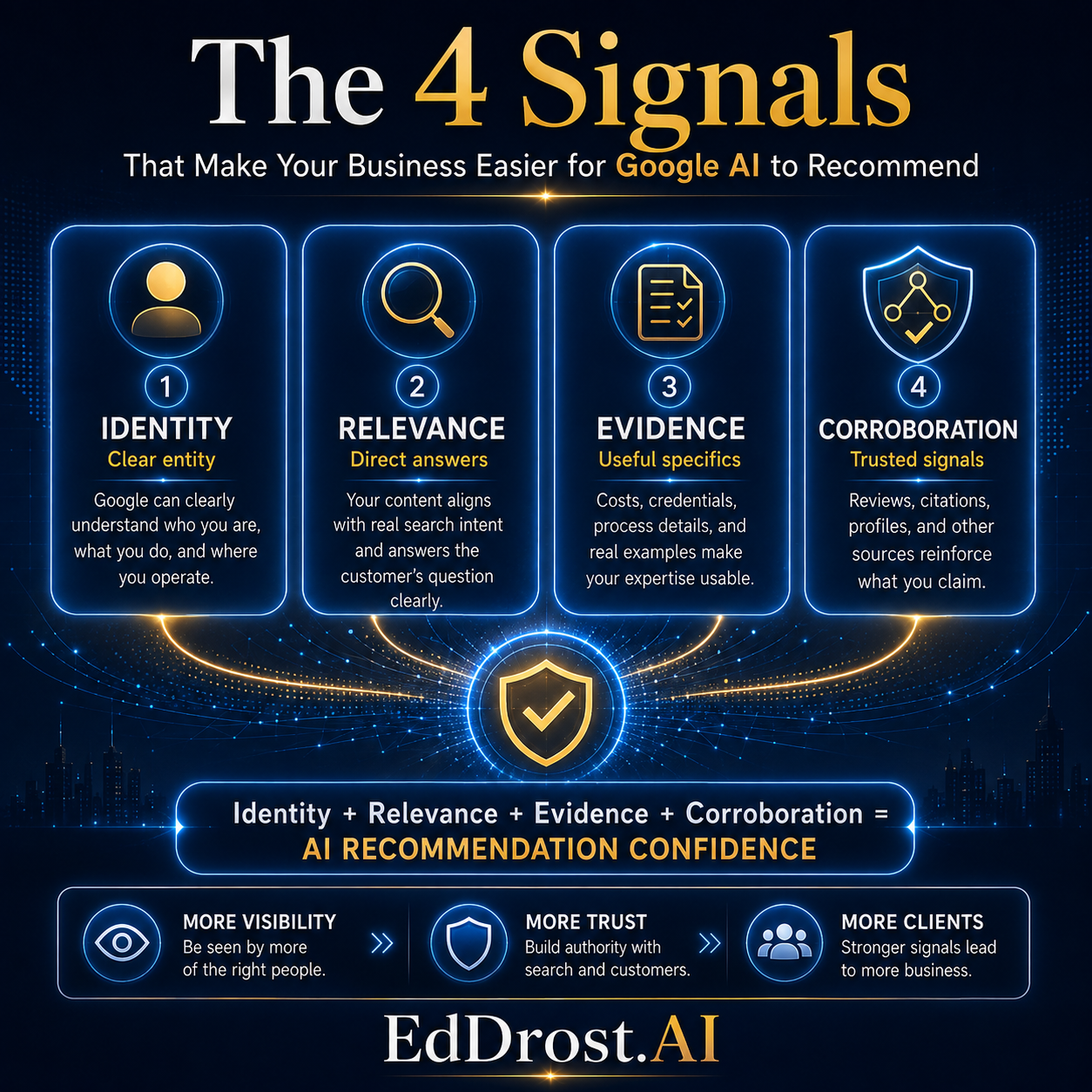
Based on those documented signals — and what I’m seeing in real AI Overview results — I believe local businesses should focus on four things:
Identity. Relevance. Evidence. Corroboration.
I call this the AI Recommendation Confidence Framework.
Identity + Relevance + Evidence + Corroboration = AI Recommendation Confidence
The stronger those four signals become, the easier it is for an AI system to understand what your business does and when your expertise may be relevant.
The Screenshot That Changed How I Look at Local Search
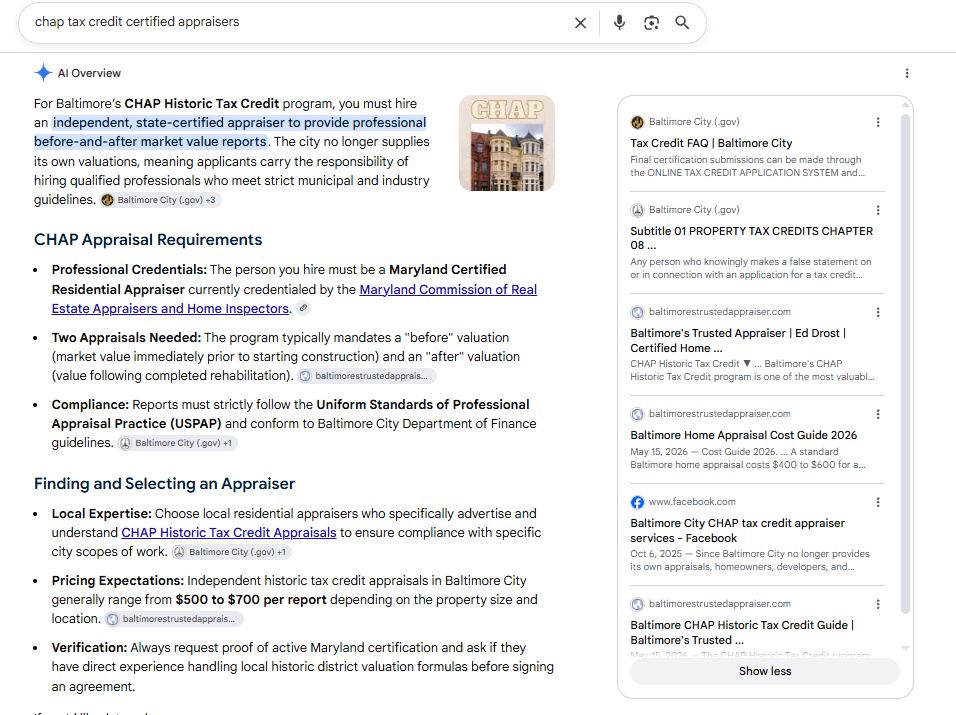
Here is what happened when I searched for:
“chap tax credit certified appraisers”
Google’s AI Overview explained the appraisal requirements for Baltimore City’s CHAP Historic Tax Credit program.
It discussed:
professional appraisal credentials,
the requirement for before-and-after valuation work,
USPAP compliance,
local expertise,
pricing expectations,
and how to select a qualified appraiser.
On the right side of the AI Overview, Google displayed supporting sources.
Baltimore City’s official website appeared.
So did BaltimoresTrustedAppraiser.com.
And my site appeared repeatedly.
That matters.
There is a major difference between:
appearing somewhere in the search results
and
being used as a source inside the answer itself.
Google was not simply saying:
“Here is Ed Drost’s website.”
It was effectively saying:
“Here are sources that help support this answer.”
That is what makes AI visibility so important.
Why Appearing Beside Baltimore.gov Matters
I want to be careful here.
I am not saying Google considers my appraisal website equal in institutional authority to Baltimore City government.
Baltimore City is obviously the primary authority on its own CHAP program.
But the screenshot shows something important.
Google found information on my website useful and relevant enough to present it alongside the official government source while answering the customer’s question.
That is the opportunity for local professionals.
You do not need to become more authoritative than the government agency.
You need to become the most useful professional source explaining the subject from the customer’s point of view.
The government explains the program.
The professional explains what the homeowner actually needs to do.
Those two sources can complement each other.
And AI systems are increasingly capable of pulling both perspectives together.
Signal #1: Identity
Can Google Clearly Understand Who You Are?
Before an AI system can recommend a business, it has to understand the business.
That sounds simple.
It often isn’t.
Google may encounter your company through:
your website,
your Google Business Profile,
professional directories,
licensing records,
social profiles,
local organizations,
reviews,
articles,
citations,
and other websites.
All of those sources contribute pieces of information.
If those pieces tell the same story, your identity becomes easier to understand.
If they conflict, uncertainty increases.
Imagine one website lists:
Residential Appraisal Solutions
Another says:
Baltimore’s Trusted Appraiser
Another contains an old phone number.
Another uses an outdated address.
Another describes services you no longer offer.
Humans can often figure that out.
Machines have to reconcile it.
That is why entity consistency matters.
Your business name, contact information, service area, credentials, specialties, and website should reinforce the same identity wherever possible.
For a local professional, this is foundational.
Do not make Google guess who you are.
Make your identity unmistakable.
Signal #2: Relevance
Does Your Content Directly Answer the Question?
Most business websites talk far too much about themselves.
AI search is trying to answer the customer.
That is a different job.
Consider two pieces of content.
The first says:
“We provide professional appraisal services with exceptional customer service.”
That's marketing language.
Now consider:
“Baltimore’s CHAP Historic Tax Credit process requires qualified appraisal work at specific stages of the rehabilitation process. Property owners should understand the appraisal requirements before beginning construction.”
That answers a real question.
It gives the search system something it can use.
That is the shift local businesses need to understand.
Instead of building a website around broad service descriptions, build it around the actual questions customers ask.
For my appraisal business, those questions include:
What does a Baltimore home appraisal cost?
Who pays for the appraisal in Maryland?
What happens when an appraisal comes in low?
Do I need an appraisal for the CHAP tax credit?
How does an estate appraisal work?
What kind of appraisal do I need for divorce?
How do I challenge an SDAT assessment?
How long does a residential appraisal take?
Each question becomes an opportunity to establish relevance.
The formula is simple:
Customer question → clear answer → local expertise → business association
That is a far more useful content strategy for AI search than stuffing one generic page with keywords.
Signal #3: Evidence
Do You Give Google Something Worth Using?
This is where decades of experience become extremely valuable.
Most business websites say roughly the same things.
“We're experienced.”
“We care about our customers.”
“We provide quality service.”
“Call today.”
An AI system cannot build a particularly useful answer from that.
What it can use is evidence.
Things like:
real numbers,
typical costs,
timelines,
requirements,
process explanations,
mistakes to avoid,
local regulations,
professional standards,
examples,
and firsthand experience.
Take the CHAP example.
Saying:
“We perform CHAP appraisals.”
is useful.
But explaining:
when the appraisal is needed, what credentials matter, what the process looks like, what mistakes homeowners should avoid, and what the work typically costs
is far more useful.
That additional value is what I think of as information gain.
You're not simply repeating the same general information found everywhere else.
You're adding something.
For professionals with 20, 30, or 40 years of experience, this is a tremendous advantage.
You already know the information customers can't easily find.
You know:
what goes wrong,
what clients misunderstand,
what matters most,
what usually costs more,
what takes longer,
what surprises people,
and which shortcuts cause problems.
That experience used to live mostly inside your head.
AI gives you leverage to turn it into searchable authority.
Experience creates the evidence. AI helps distribute it.
Signal #4: Corroboration
Does the Rest of the Web Support What You Say?
Your own website can claim almost anything.
That does not make it true.
This is where independent signals become important.
Google can encounter information about your business through reviews, directories, websites, articles, links, local organizations, professional profiles, and other third-party sources.
If all of those sources reinforce the same message, the conclusion becomes stronger.
Suppose your website says:
“We specialize in Baltimore CHAP tax credit appraisals.”
Then Google also finds:
multiple CHAP educational pages on your website,
professional appraisal credentials,
relevant service descriptions,
reviews from real clients,
local business listings,
supporting references from other websites,
and detailed articles covering the same specialty.
Those sources begin telling the same story.
That is corroboration.
It is the difference between:
“I say I’m an expert.”
and
“The available evidence consistently connects me with this subject.”
That is a much stronger position.
And it is one of the reasons I believe narrow local authority can become so powerful in AI search.
The Bigger Lesson Hidden in My AI Overview Screenshot
Something else stood out when I looked carefully at the result.
Google was not relying on one page from my website to answer everything.
Different pages appeared to support different parts of the response.
One page related to CHAP.
Another related to appraisal costs.
Another explained broader appraisal services.
That tells me something important.
AI authority may not be built from one perfectly optimized page.
It may be built from a connected body of useful information around a subject.
Think about the difference.
One page says:
Baltimore CHAP appraisals
Ten interconnected pages explain:
who needs one,
when they are required,
what they cost,
how the process works,
what credentials matter,
what homeowners should avoid,
how CHAP relates to renovation,
how valuation works,
and what happens next.
Now Google has an entire knowledge cluster.
That creates topical depth.
And topical depth may make it easier for AI systems to understand what your business is genuinely known for.
Stop Thinking Like an Advertiser
For years local businesses were taught to make websites that sell.
Big headlines.
Strong calls to action.
Testimonials.
Lead forms.
“Call today.”
Those still matter.
But AI search introduces another role for your website.
Your website also needs to function as a reference source.
A reference:
answers questions,
explains processes,
provides specifics,
establishes authorship,
demonstrates experience,
stays accurate,
and can be corroborated elsewhere.
That changes the mindset.
Instead of asking:
“How do I make this page sell harder?”
ask:
“Would an AI system trust this page enough to use it when answering a customer's question?”
That one question changes the way you write content.
SEO Is Not Dead — But the Goal Is Changing
I previously wrote:
Why Local SEO Is Dead — And AI Visibility Just Replaced It
The headline was intentionally provocative.
Traditional SEO is not literally disappearing.
Google Business Profile optimization still matters.
Technical SEO still matters.
Internal links still matter.
Backlinks still matter.
Local citations still matter.
Helpful content still matters.
Traditional organic rankings still matter.
But the objective is expanding.
The old goal was:
Rank #1.
The new goal is increasingly:
Become part of the answer.
That's why I frame the evolution this way:
SEO earns eligibility. Authority earns citation. Clarity earns recommendation.
Ranking gets you into the competition.
Authority gives systems a reason to trust you.
Clarity makes your expertise easy to understand and use.
What Local Businesses Should Do Right Now
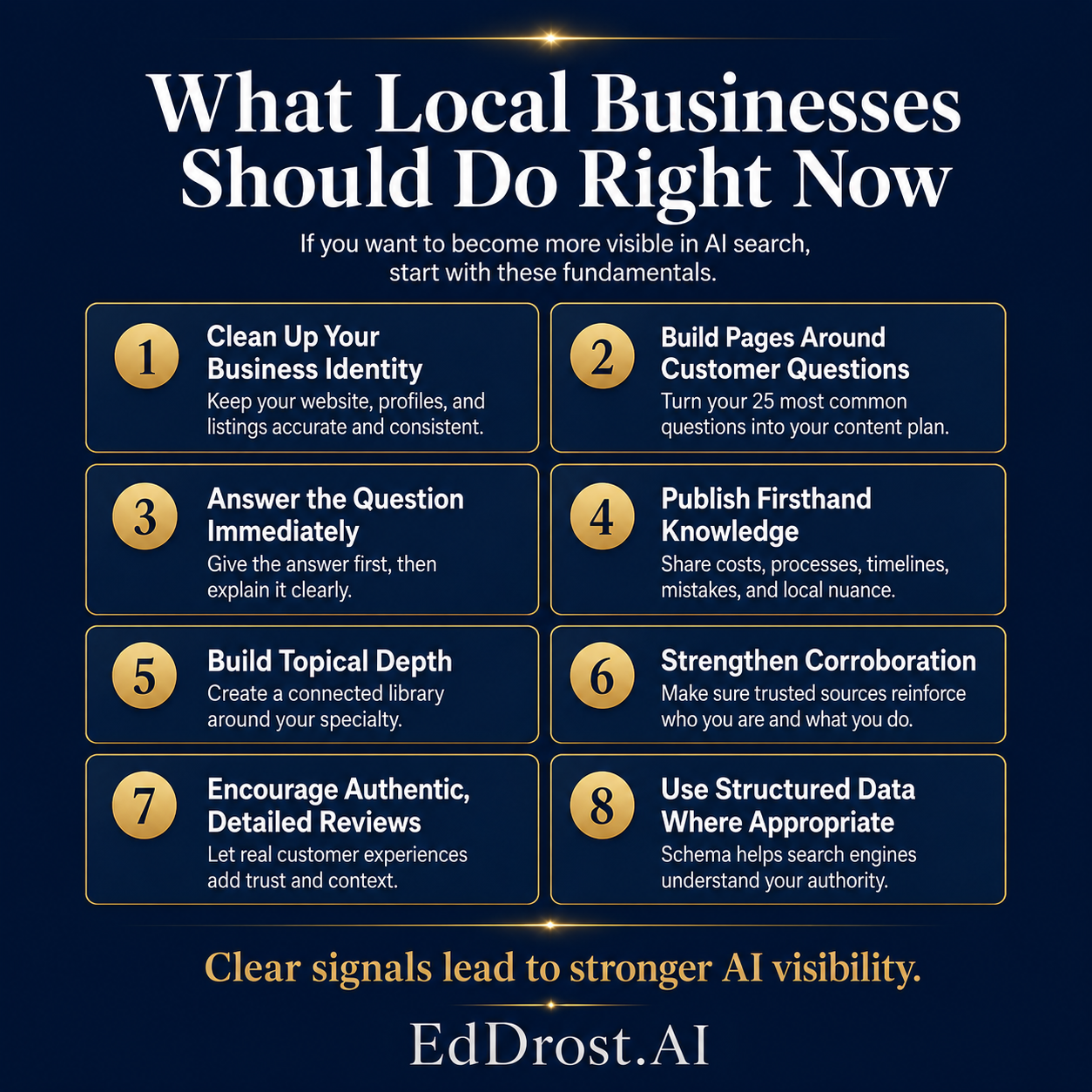
If you want to become more visible in AI search, start with these fundamentals.
1. Clean Up Your Business Identity
Make sure your business information is accurate and consistent across your website, Google Business Profile, professional profiles, and major listings.
2. Build Pages Around Customer Questions
Write down the 25 most common questions customers ask before hiring someone in your profession.
Those questions are your content plan.
3. Answer the Question Immediately
Do not make the reader work through 700 words to discover the answer.
Give them the answer first.
Then explain it.
4. Publish Firsthand Knowledge
Include the details that come from actually doing the work.
Costs.
Processes.
Timelines.
Mistakes.
Requirements.
Examples.
Local nuance.
5. Build Topical Depth
Don't publish one article on your specialty and move on.
Build a connected library around it.
6. Strengthen Corroboration
Make sure other legitimate sources across the web consistently reinforce who you are and what you do.
7. Encourage Authentic, Detailed Reviews
Never script or manufacture reviews.
But real customers often naturally mention the service they received, the problem you solved, and what stood out about the experience.
That context is useful to future customers and strengthens your broader digital footprint.
8. Use Structured Data Where Appropriate
Schema markup can help search engines interpret information about your organization, services, authors, and content.
Schema does not manufacture authority.
It helps clarify authority you have already established.
The AI Recommendation Confidence Framework
If you remember nothing else from this article, remember these four words:
Identity
Can the AI clearly understand who you are?
Relevance
Does your content directly answer the customer's question?
Evidence
Do you provide useful information worth including in the answer?
Corroboration
Does independent information across the web support what you claim?
Together:
Identity + Relevance + Evidence + Corroboration = AI Recommendation Confidence
This is not an official Google scoring system.
It is the practical framework I use to think about AI visibility.
And the more I test it, the more useful it becomes.
Why This Matters for Experienced Professionals
I believe professionals over 45 may have one of the biggest opportunities in the AI era.
Not because we're necessarily the fastest adopters of every new technology.
But because we have something AI cannot manufacture overnight.
Experience.
Thirty years of professional work creates thousands of observations.
Questions.
Stories.
Mistakes.
Judgment calls.
Processes.
Patterns.
Lessons.
Those are exactly the kinds of insights that can make content useful.
The opportunity is to take that accumulated expertise and make it understandable to both people and machines.
That is where AI becomes leverage.
You do not need to become an “AI influencer.”
You need to turn what you already know into digital authority.
Frequently Asked Questions
Why did Google AI cite BaltimoresTrustedAppraiser.com?
Google has not published the exact reason one specific source is selected for an AI Overview. In this case, my website contained detailed, locally relevant information about Baltimore CHAP appraisals, appraisal costs, professional credentials, and related services. Google surfaced several of those pages alongside official Baltimore City sources while answering the query.
Does being cited in an AI Overview mean Google officially endorses my business?
No.
A citation means Google's system used or surfaced information from a source in connection with the generated answer. It should not be interpreted as a formal Google endorsement of the business.
Is being cited different from ranking #1?
Yes.
Traditional rankings determine where a page appears in search results.
AI citations involve a source being used or displayed in connection with an AI-generated answer.
The two can overlap, but they are not the same thing.
Do I need a large website to get cited by Google AI?
Not necessarily.
A smaller site with deep expertise on a narrow subject can be extremely relevant for a specific question.
A hundred generic pages do not automatically beat ten highly useful ones.
What is AI Recommendation Confidence?
AI Recommendation Confidence is my framework for evaluating whether an AI system can clearly understand and corroborate a business's expertise.
The four components are:
Identity, Relevance, Evidence, and Corroboration.
It is not an official Google ranking factor or metric.
Can AI Recommend Your Business Today?
Here's the question I think every local professional should ask:
If someone asked Google, ChatGPT, Gemini, or another AI platform to recommend an expert in my field today, would it understand enough about my business to include me?
Would it know:
Who you are?
Where you operate?
What you specialize in?
Why you're qualified?
What questions you can answer?
What customers know you for?
Whether independent sources support your expertise?
If you're not sure, that's the diagnostic.
You don't need more generic content.
You need clearer digital evidence.
You need stronger authority.
You need a business AI systems can understand.
Want to see how visible your business is to AI?
Visit EdDrost.AI and run an AI Visibility Diagnostic.
And if you need a residential appraisal in the Baltimore area for CHAP, estate, divorce, pre-listing, or SDAT assessment appeal purposes, visit BaltimoresTrustedAppraiser.com.
The future of local search isn't simply being found.
It's being understood.
It's being trusted.
And increasingly—
it's being recommended.
Ed Drost is a Maryland Certified Residential Appraiser with 36+ years of Baltimore-area experience and the founder of BaltimoresTrustedAppraiser.com and EdDrost.AI. He helps local professionals turn real-world expertise into AI visibility, authority, and trust.
Experience builds value. AI builds leverage.
- Aug 23
Why Google AI Recommended My Baltimore Appraisal Business — And the 4 Signals That Made It Possible
- Ed Drost
- AI Visibilty Architect
- 0 comments