The Invisible Expert Series — Day 2
In Day 1, I told you about the Invisible Expert Problem — how decades of real-world authority can leave a seasoned professional nearly invisible to the AI tools clients now reach for before they ever pick up the phone.
Today I want to answer the question that actually keeps agents up at night: in this new world, who gets the client? Because the answer has quietly changed — and it isn't who you'd think.
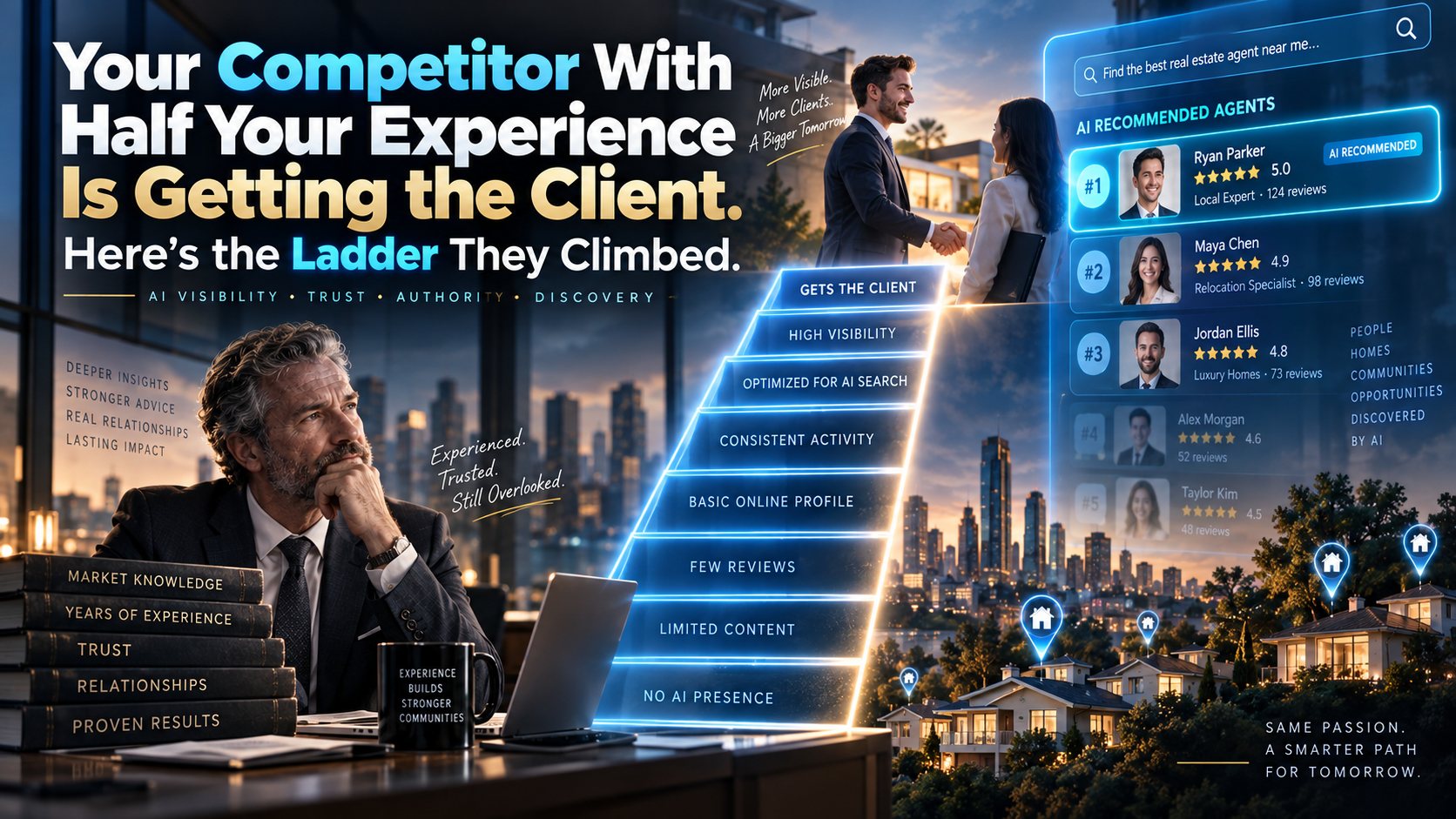
The client's first move isn't a phone call anymore
Walk through what actually happens now when someone needs an agent.
They don't ask their neighbor and dial a number. They open their phone and type a question — "best real estate agent near me for selling an older home," or "who should I hire to sell my house in [your town]." And more and more, the first thing they see isn't ten links to compare. It's an AI-written answer at the top of the page.
This isn't fringe behavior. A February 2026 Pew survey found 60% of U.S. adults now say they read those AI summaries at the top of their search results. And when that summary shows up, the clicks to everyone's website below it fall off a cliff — Pew found people clicked a traditional search result only 8% of the time when an AI summary was present, versus 15% when it wasn't. They clicked a link inside the summary just 1% of the time.
So here's the uncomfortable truth for experienced agents: your prospect increasingly isn't comparing a field of ten. An AI system searches the market, synthesizes what it finds, and hands them a much shorter list of names it believes answers the question.
If you're not on that short list, you were never in the running. And you'll never know it happened.
The best agent doesn't win the AI. The most verifiable one does.
This is the part that stings, so I'll say it plainly. The AI isn't picking the best agent. It can't. It has no way to know you out-negotiate, out-service, and out-close the competition.
What it can do is find the professional whose expertise is clear, retrievable, and verifiable — documented in a way both people and machines can read. That's who gets named.
And "ranked #1 on Google" is no longer the same thing as "named by the AI." In one Ahrefs study of 15,000 prompts across ChatGPT, Gemini, Copilot, and Perplexity, only 12% of the URLs the AI cited also ranked in Google's top ten for the same prompt. Being on top of the old search results doesn't guarantee you a seat at the new table.
Why the old playbook stopped protecting you
For twenty years, the script was simple: build a site, load it with local keywords, chase backlinks, fight for the top ten. Every marketer sold it.
That script isn't wrong so much as it's no longer the whole game. SEO still matters — strong visibility and authority still help you get found, and ranking well and getting cited do overlap. SEO is the foundation.
But being #1 isn't the finish line anymore. There are two more floors built on top of it now, and they decide who gets the client:
SEO gets you found. GEO gets you understood. AEO gets you quoted. Authority gets you chosen.
That's the ladder. Most experienced agents are stuck on the bottom rung — findable, maybe, but not understood, quoted, or chosen. The client goes to whoever climbed higher.
How the machine actually decides who to name
When a buyer or seller asks a real question, the AI doesn't just hunt for a page with those exact words. Google has confirmed its AI Mode uses a technique called query fan-out — it breaks one question into multiple related subtopics and searches them at once, then assembles an answer.
To get named in that answer, a few things separate the agents who get cited from the ones who get ignored:
The crawlers can actually read your site. If your server is quietly blocking the AI bots, you're invisible no matter how good you are.
You answer the small questions, not just the big one. Pages that address the real sub-questions a client has — how do I sell an inherited home, what hurts value in this neighborhood, how long are homes sitting here — get cited more often than pages chasing a single headline keyword.
Your answers are extractable. The AI favors a clean, self-contained answer sitting right under a plain-English question, the way a person actually asks it.
Your business is machine-readable. Google explicitly recommends Organization and LocalBusiness structured data so it can understand your name, address, phone, and service area. It's not a magic button — nothing is — but it's a supporting signal that helps the machine correctly understand who you are. Most agents skip it.
And other sources back you up. The AI cross-checks — your listings, reviews, a local news mention, a video transcript. It wants the same story about you confirmed in more than one place before it recommends you.
The good news for the seasoned pro
Total clicks are shrinking because AI answers so much on the spot. But the visitors who do reach you can carry stronger intent — one 2026 ecommerce analysis found ChatGPT-referred traffic converted about 31% higher than non-branded organic search across the sites studied. That's ecommerce data and the evidence is still emerging, but the logic holds anywhere: by the time someone clicks through from an AI answer, the machine has already vetted your credentials, confirmed you serve their area, and presented you as an authority. They're not window-shopping. They're most of the way to sold.
AI made information cheap. It made a verified expert more valuable than ever. Anyone can generate a market stat — nobody can fabricate the deals you've personally closed on these streets.
Three moves that put you on the short list
You don't need to rebuild your whole site or post six times a day. You need three adjustments:
Format for extraction. Turn your hard-won local knowledge into clear, self-contained answers under plain-language questions — the way a client actually asks them.
Anchor your credentials. Make your name, license, office, and service area machine-readable and consistent everywhere the AI can find them.
Build consensus. Put your best market insights in more than one place so the AI keeps seeing the same story about you, confirmed from multiple directions.
This is exactly the move I made with BaltimoresTrustedAppraiser.com — a site built page by page, zip code by zip code, in clean answers only a licensed local can give. It hit Page 1 of Google and landed inside Google's AI answer within 72 hours. Not because it was big. Because it was clear, retrievable, and verifiable — which is what gets you named now.
In the AI-search era, being the best agent in your market means little if the machines can't verify you. The professionals who structure their expertise for machine trust today will be the ones getting the client tomorrow.
Curious what AI actually says about you right now? I'll run a free Invisible Expert check and show you exactly where you show up, where you disappear, and what to fix first. Start at eddrost.ai or call me directly at 443-904-5229.
Experience builds value. AI builds leverage. — Ed Drost, Baltimore's Trusted Appraiser · MD Certified Residential Appraiser #30004874
- Yesterday
The Invisible Real Estate Expert: Why AI Search Is Changing Who Gets the Client
- Ed Drost
- AI Visibilty Architect
- 0 comments