You can spend 20, 30, even 40 years mastering this business and still be almost invisible in the one place that now decides who gets called.
I know, because I was.
A while back I sat down one afternoon and asked Google — and then the AI tools — a simple question: what do you actually know about Ed Drost, the appraiser? The answer was thin. Nearly four decades of estate files, divorce valuations, SDAT appeals, CHAP historic credits, block-by-block knowledge you can't fake — and online, I looked about the same as someone who'd gotten their license last Tuesday.
That's the paradox hitting experienced professionals right now. Your real-world authority is strong. Your digital authority is thin. And in the AI era, that gap is quietly handing your clients to someone else.
I call it the Invisible Expert Problem.
You don't have an expertise problem
Let's clear this up first, because almost everybody gets it backwards.
Your problem isn't that you need more training. You don't need another certification, another platform, or a content calendar that eats six hours of your day. You need something different — to make the expertise you already have easy to find, understand, trust, and recommend.
There's a world of difference between having authority and being recognized as an authority online. You may have walked hundreds of families through a sale. You may have valued a neighborhood for twenty years. But Google and AI don't automatically know any of that, and neither does the prospect sitting there with their phone. If your experience isn't visible, documented, and backed by proof, you look remarkably similar to someone with no track record at all.
The market changed the rules while we were working
For most of my career, reputation moved by word of mouth. Someone needed an appraiser, asked their agent or a friend, got a name and a number. That still happens. Referrals still matter.
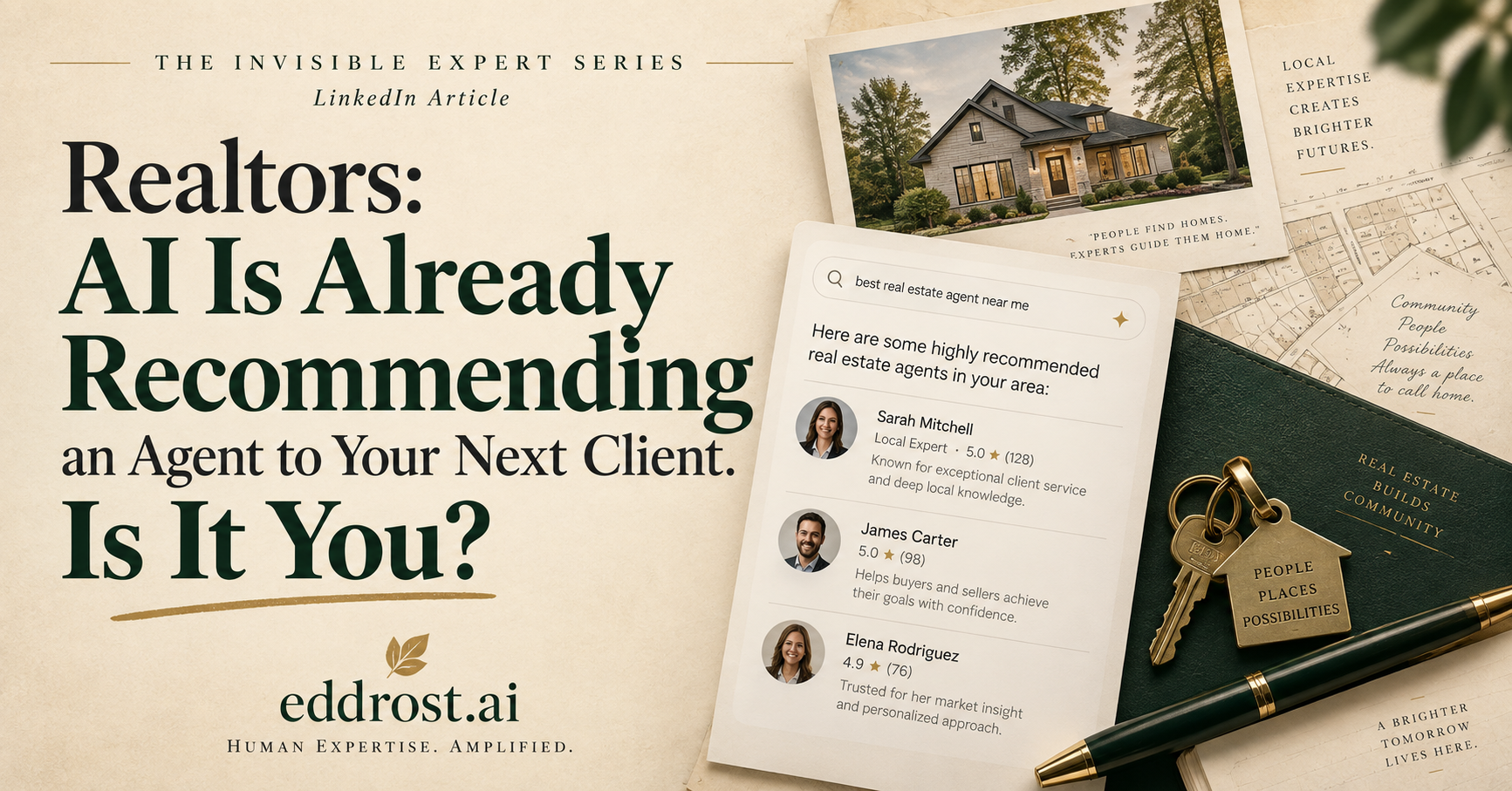
But they aren't the whole decision anymore. Today even a referred prospect checks you out before they dial. They search your name. They glance at reviews. And more and more, they ask an AI assistant a plain question:
"Who's the best appraiser near Baltimore for an estate settlement?"
"Who should I hire to value an older rowhome?"
Whatever that AI answers is the new first impression. If your name isn't in it, you were never in the running — and you'll never even know it happened.
The best professional doesn't automatically win
Here's the hard part for a seasoned pro to hear, so I'll just say it. The best person doesn't always get discovered. The clearest person does. The one whose expertise is documented in a way both people and machines can read is the one who gets recommended.
That stings when you know you've got more years than whoever's showing up instead of you. But it's also good news, because "clear" is fixable. Your experience still counts. You just have to translate it into a form the modern discovery systems can actually see.
So I stopped complaining and built the thing myself
I didn't read about this problem. I lived it — and then I did something about it.
Once I saw how invisible I was, I rebuilt from scratch and put up BaltimoresTrustedAppraiser.com — a 74-page site covering the exact market I serve, page by page, zip code by zip code. Not generic filler. Not "trusted, experienced, full service" like every other site out there. I wrote the specific, firsthand answers only a licensed local appraiser can give: why a CHAP Historic Tax Credit swings value on a particular block, why a Canton rowhome doesn't compare to one two streets over in Butchers Hill, what actually happens in an SDAT tax appeal.
Every page did one job — take something I knew cold after 37 years and make it readable to both a homeowner and a machine.
Within 72 hours, that site earned a Page 1 Google ranking and a citation inside Google's AI answer. Not just ranked — recommended by the AI. I had become Case Study #1 for my own method, and I proved it on the hardest test I owned before I ever took it to anyone else.
That build is the whole argument in one place: I didn't out-produce the internet on information. I took hard-won experience and finally made it visible.
Why experienced professionals go invisible
The same reasons come up again and again:
Your website sells services, not expertise — and every competitor uses the identical words. Your best knowledge lives in your head, where it can't build authority. Your content is too generic — "five tips for sellers" is something AI writes in three seconds and thousands already have. There isn't enough proof — credentials, real numbers, actual markets served. And there's no clear positioning, so a prospect can't answer the one question that matters: what is this person especially good at?
The advantage is yours now
Here's what most people miss. AI made information cheap. Experience is still expensive.
Anyone can generate an article. Anyone can summarize a market stat. But AI can't personally live through 37 years of Baltimore transactions. It can't manufacture judgment or recreate the relationships you earned the hard way. So the move isn't to out-write the machines on information — it's to use them to make your real experience finally visible.
That's the line I keep coming back to: experience builds value, AI builds leverage.
From invisible expert to obvious choice
When I rebuilt my own presence, I did it in five stages — the same path I now walk experienced professionals through:
Positioned — clear on the one thing you want tied to your name. Visible — that expertise easy to discover across your site, search, and profiles. Trusted — enough evidence for people and AI to believe you. Recommended — documented authority that Google, AI, and referral partners can confidently put forward. Chosen — a simple path from "I trust this person" to "I'm calling them."
And no, you don't have to become a content creator. One 30-minute conversation about what you really know can become an article, a short video, a handful of posts, an email, and an answer AI can quote. The goal was never more content. It's turning the knowledge you already carry into authority people can see.
The Invisible Expert Test
Ask yourself, honestly:
If someone landed on your website for 30 seconds, would they know exactly what you're uniquely qualified to help with?
If someone searched your name, would the results match the reputation you've earned offline?
If ChatGPT or Google AI researched your specialty, would it find enough to understand why you're credible?
Does your content carry your perspective — or things anyone could publish?
Is there a clear next step for someone who decides they trust you?
Several "no"s? You've got an Invisible Expert problem. And it's fixable — I know, because I fixed my own and built the site that proves it.
Your experience is still the asset
Platforms change. Search changes. AI will keep changing. But expertise, judgment, trust, and reputation still matter — they always will. You already did the hard part. You spent years becoming the expert. The only job left is making sure the market can see it, because expertise that stays invisible can't create a single opportunity.
Curious what AI actually says about you right now? I'll run a free Invisible Expert check and show you where your expertise shows up, where it disappears, and what to fix first. Start at eddrost.ai or call me directly at 443-904-5229.
Experience builds value. AI builds leverage. — Ed Drost, Baltimore's Trusted Appraiser · MD Certified Residential Appraiser #30004874
- Sep 19
The Invisible Expert Problem: Why Experienced Real Estate Professionals Get Overlooked Online
- Ed Drost
- AI Visibilty Architect
- 0 comments