Why ranking in Google is no longer enough — and how SEO, AEO, and GEO work together to make your business discoverable, quotable, and citeable by AI.
Last spring, a Federal Hill business owner told me he had “already done SEO.”
He had paid an agency years earlier, ranked well, and assumed the job was finished.
Then he searched for his own service on ChatGPT.
The answer recommended three competitors.
His business was never mentioned.
He had optimized for a game that had quietly changed underneath him.
I’ve been a Maryland Certified Residential Appraiser since 1989, with 36 years of experience handling Baltimore-area estates, divorces, CHAP historic properties, and complex residential valuation assignments. Over the last two years, I’ve also been studying how AI-driven search changes the way local businesses are discovered.
And much of that change comes down to three terms:
SEO. AEO. GEO.
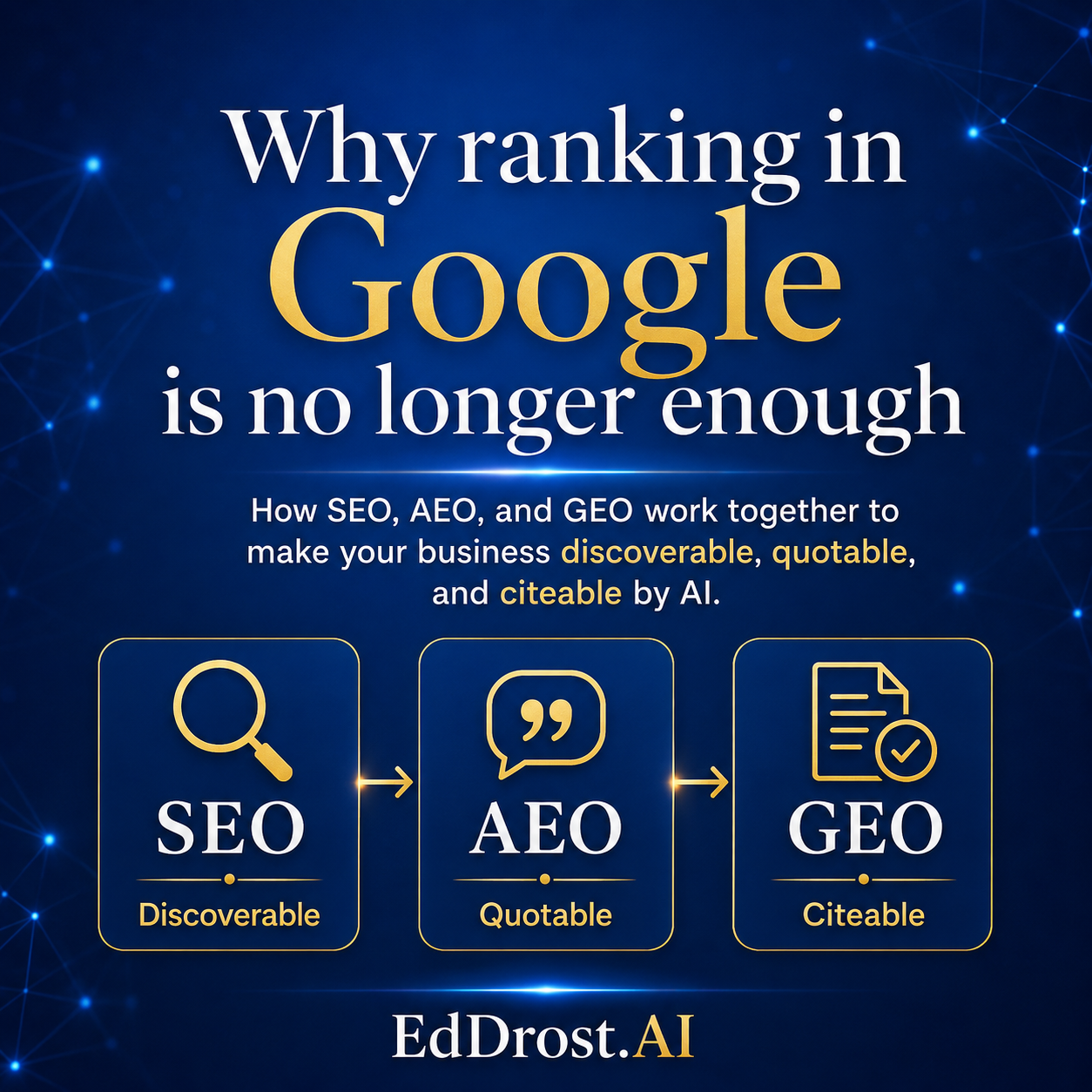
They are related.
But they are not the same thing.
If you optimize for only one, you can still become invisible in the other two.
Here is the simple distinction:
SEO gets you ranked.
AEO helps you become the answer.
GEO helps you become a cited source inside generative AI.
In 2026, local businesses increasingly need all three.
SEO: The Game You Already Know
Search Engine Optimization is the traditional discipline most business owners recognize.
SEO focuses on helping your website appear prominently when someone searches for a product, service, or answer.
That can involve:
keyword targeting,
backlinks,
internal linking,
page speed,
technical SEO,
local citations,
Google Business Profile optimization,
useful content,
and strong website architecture.
If someone searches:
“certified appraiser Baltimore County”
and clicks your website from the organic results, SEO helped put you there.
SEO still matters.
In fact, it remains the foundation for much of online visibility.
But ranking is no longer the only outcome that matters.
Today, the searcher may receive a direct answer, an AI Overview, a map recommendation, a featured result, or a conversational response before ever clicking a traditional blue link.
That changes the objective.
AEO: Being the Answer, Not Just the Link
Answer Engine Optimization, or AEO, focuses on making your content easy for search engines and AI-powered answer systems to understand and use when responding to a question.
The difference is subtle but important.
Traditional SEO asks:
How do I rank this page?
AEO asks:
How do I make the answer on this page clear enough to be extracted and surfaced directly?
Imagine someone asks:
“Who should I hire for an estate appraisal in Baltimore?”
A well-structured answer page might begin:
Direct Answer: Hire a Maryland Certified Residential Appraiser with specific experience in estate, probate, date-of-death, and retrospective valuation in the Baltimore market. The appraiser should understand historical local market conditions and be able to produce a clear, defensible report for executors, attorneys, CPAs, and heirs.
That answer is useful even if the reader sees only that paragraph.
How AEO Content Is Structured
AEO-friendly content generally benefits from:
question-based headlines,
direct answers near the top of the page,
concise explanations,
descriptive headings,
tables and lists where appropriate,
clear definitions,
FAQs,
and structured data when relevant.
The goal is not to “trick” an AI system.
The goal is to remove ambiguity.
If your content clearly answers the question, the system has less work to do to understand what you are saying.
That is why I have increasingly rebuilt my own content around direct customer questions instead of generic service-page copy.
GEO: Getting Cited by Generative AI
Generative Engine Optimization, or GEO, focuses on a different outcome.
Instead of merely ranking a page or becoming a featured answer, GEO is about becoming a useful source inside responses generated by systems such as:
ChatGPT,
Google AI Overviews and AI Mode,
Gemini,
Perplexity,
and other conversational search platforms.
Generative systems often combine information from multiple sources into a synthesized response.
When citations or supporting links are shown, the commercial opportunity is obvious:
Can your business become one of the sources supporting the answer?
That is where entity clarity becomes especially important.
The system needs to connect:
your name → your business → your specialty → your location → your evidence
That is a much deeper relationship than matching one keyword on one page.
What GEO Looks Like in a Real Baltimore AI Overview
I have seen this happen with my own appraisal business.
When I searched Google for: who does chap tax credit appraisals
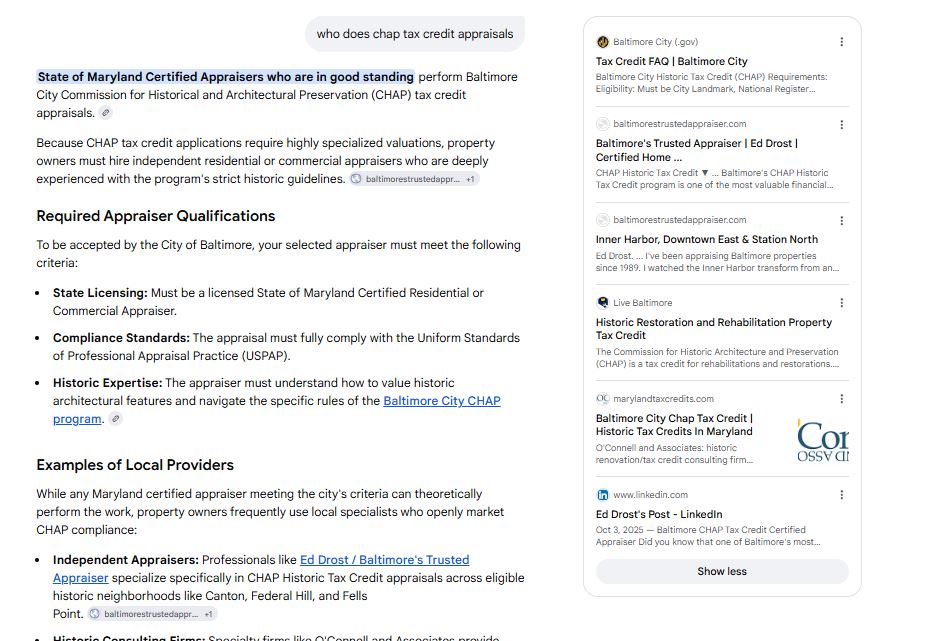
This AI Overview result is a strong example of how AI visibility differs from traditional ranking. For the search “who does CHAP tax credits Appraisals,” Google’s AI Overview explains the CHAP appraisal requirements, identifies the need for a licensed Maryland Certified Residential Appraiser, and then names Ed Drost / Baltimore’s Trusted Appraiser under Local Specialists with more than 36 years of experience handling CHAP-specific before-and-after valuations. The source panel also cites multiple pages from BaltimoresTrustedAppraiser.com alongside official Baltimore City resources. That is the kind of visibility local professionals should pay attention to: the goal is no longer only to rank for a keyword, but to become a trusted source the AI can use to explain the topic, verify the professional, and recommend a qualified provider.
Google’s AI Overview surfaced information from BaltimoresTrustedAppraiser.com.
In another search asking who could complete a CHAP tax credit appraisal in Baltimore, Google’s AI-generated answer named me and surfaced my website alongside official Baltimore City sources.
That was significant.
The AI did not simply place my homepage somewhere in a list of search results.
It used information associated with my business while constructing the answer.
The source panel also surfaced multiple pages from my site, including CHAP-related content and appraisal cost information.
That is the distinction local businesses need to understand.
Ranking vs. Citation
Traditional search visibility might look like this:
Search → ranked result → website click
Generative visibility can look more like:
Question → AI-generated answer → cited source or named business
Those are different customer journeys.
And increasingly, businesses need to prepare for both.
SEO, AEO, and GEO Solve Different Problems
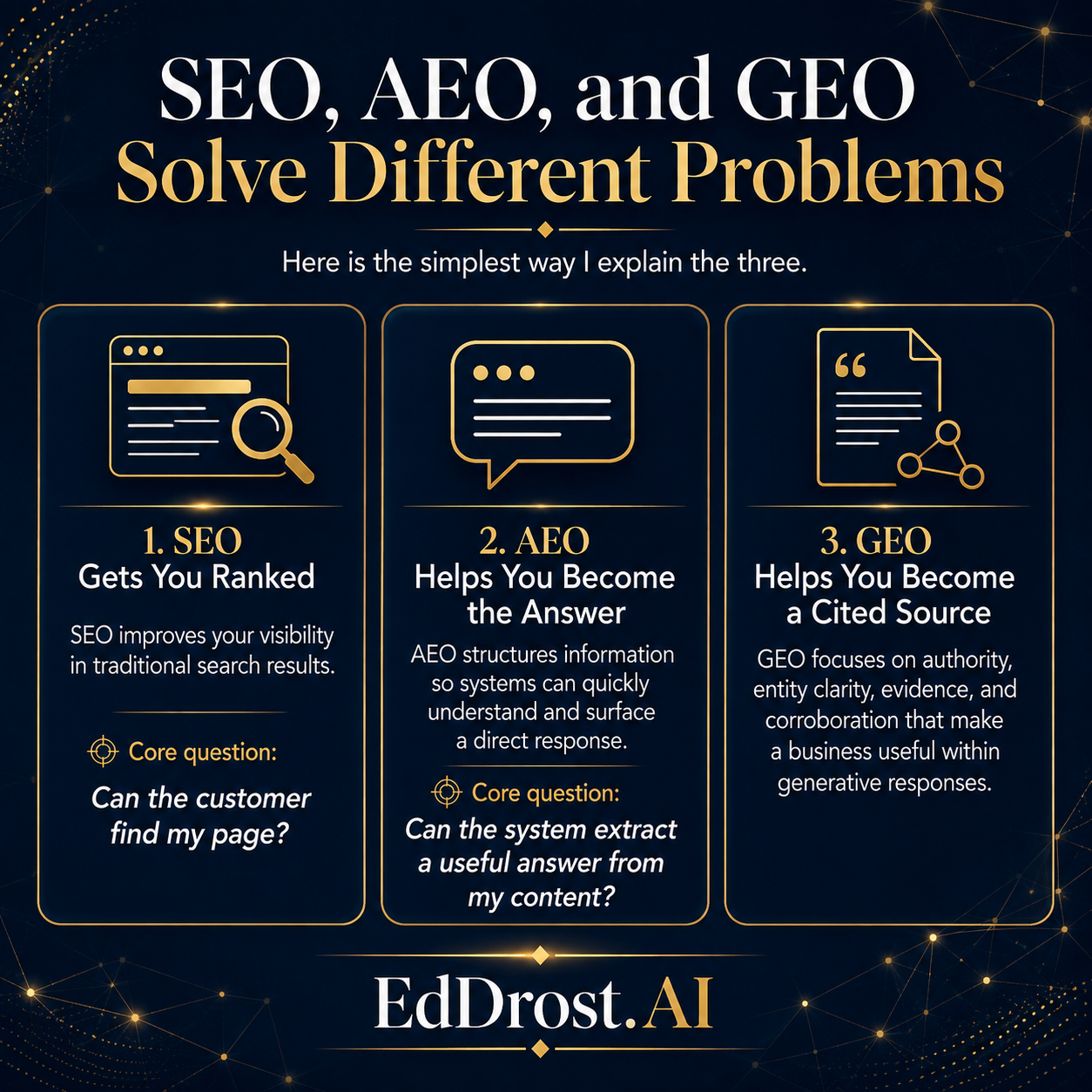
Here is the simplest way I explain the three.
SEO Gets You Ranked
SEO improves your visibility in traditional search results.
Its core question is:
Can the customer find my page?
AEO Helps You Become the Answer
AEO structures information so systems can quickly understand and surface a direct response.
Its core question is:
Can the system extract a useful answer from my content?
GEO Helps You Become a Cited Source
GEO focuses on the broader authority, entity clarity, evidence, and corroboration that can make a business useful within generative responses.
Its core question is:
Can AI systems understand who I am and trust my information enough to use it?
You should not choose one.
A strong local digital presence increasingly needs all three working together.
Why 2026 Is the Line in the Sand
The distinction matters because customer discovery is changing.
Three shifts stand out.
The Answer Is Competing With the List
Traditional search forced the user to evaluate multiple results.
AI-generated search can reduce that process by assembling information before the user visits a website.
That means visibility increasingly depends not only on appearing in the results but also on contributing to the answer.
If the system already gives the searcher:
the explanation,
the provider,
the qualifications,
the approximate cost,
and the next step,
the searcher may never evaluate ten competing homepages.
Early Authority Can Compound
I would not claim that being cited once permanently locks a business into future answers.
AI-generated results can change.
But there is a practical advantage to building strong digital authority early.
When your website repeatedly provides:
consistent identity information,
detailed service pages,
useful answers,
firsthand expertise,
strong corroborating signals,
and clear entity relationships,
you create more evidence for search systems to understand.
The goal is not to chase one citation.
The goal is to build a body of evidence that continues reinforcing the same conclusion:
This person is associated with this specialty in this market.
Your Experience Only Counts If Machines Can Understand It
This may be the most important shift for experienced professionals.
You can have 20, 30, or 40 years of expertise.
You can have:
exceptional technical knowledge,
a strong local reputation,
hundreds of satisfied clients,
specialized credentials,
and experience your competitors cannot duplicate.
But if that knowledge exists only inside your head, or is buried in vague website copy, search systems may not fully understand it.
That is why the opportunity is so significant for professionals with decades of experience.
You already own the hardest asset to create:
real-world expertise.
The next step is making it digitally understandable.
The AI Visibility Formula for Local Businesses
I think about the transition this way:
SEO builds discoverability.
AEO builds answer clarity.
GEO builds generative authority.
Together, they help create what I call AI Visibility.
AI visibility is the degree to which search and conversational systems can accurately understand:
who you are,
what you do,
where you operate,
what you specialize in,
why you are qualified,
and when your business is relevant to a specific customer question.
That is a very different goal from simply “ranking for keywords.”
How to Test Your Own Business for AI Visibility
You do not need sophisticated software to perform a basic test.
Open several AI-powered search tools and ask the questions a real customer would ask.
For example:
“Who would you recommend for an estate appraisal in Baltimore?”
“Who specializes in CHAP tax credit appraisals in Baltimore?”
“Who helps Baltimore businesses improve AI visibility?”
Then look at what happens.
Ask These Questions
Does the system mention your business?
Does it describe your services accurately?
Does it confuse you with another company?
Does it recommend competitors instead?
Does it cite your website?
Which pages does it use?
Is your location correct?
Are your credentials accurate?
What attributes does it associate with your name?
That is the beginning of an AI visibility audit.
Why Local Businesses Need All Three
A business with strong SEO but weak AEO may rank well but fail to become part of direct answers.
A business with good AEO but weak entity authority may produce useful content while the system remains unsure who the business is.
A business pursuing GEO without basic SEO fundamentals may make its information difficult to crawl, discover, or understand in the first place.
The strongest strategy is layered.
Layer 1: SEO
Make the website technically accessible and discoverable.
Layer 2: AEO
Make individual answers clear, useful, and extractable.
Layer 3: GEO
Build the entity, authority, evidence, and corroboration around the business so generative systems can connect the source to the expert.
That is the new stack.
What Experienced Professionals Should Do Next
If you have decades of professional experience, do not begin by trying to publish hundreds of generic AI-generated articles.
Start with the questions you have answered throughout your career.
Write down:
the questions clients repeatedly ask,
the mistakes you repeatedly see,
the situations generic advice gets wrong,
the local details outsiders miss,
the cost ranges you understand,
the processes customers find confusing,
and the professional judgment that comes only from experience.
Then build content around those answers.
That gives SEO something to discover.
It gives AEO something to extract.
And it gives GEO something worth citing.
Frequently Asked Questions
What Is the Difference Between SEO, AEO, and GEO?
SEO helps webpages rank in traditional search results. AEO structures content so answer engines can clearly understand and surface direct answers. GEO focuses on building the authority, evidence, and entity clarity needed for a business or source to appear inside generative AI responses.
Does Traditional SEO Still Matter in 2026?
Yes. SEO remains foundational because search systems still need to discover, crawl, understand, and evaluate web content. What has changed is that ranking is no longer the only visibility outcome businesses should pursue.
What Is Answer Engine Optimization?
Answer Engine Optimization is the practice of structuring content so search engines and AI-powered systems can quickly identify a clear, useful answer to a specific question.
What Is Generative Engine Optimization?
Generative Engine Optimization focuses on increasing the likelihood that a brand, expert, or webpage can become a useful source within AI-generated responses. GEO typically involves entity clarity, original information, topical authority, corroboration, and content that clearly demonstrates expertise.
How Do I Know If My Business Is Optimized for AI Search?
Search for your business category using realistic customer questions in Google AI, ChatGPT, Gemini, Perplexity, and other discovery platforms. Compare whether your business is mentioned, accurately described, cited, or omitted. The gaps reveal where your AI visibility strategy needs work.
The Bottom Line for Experienced Professionals
I spent 36 years building a professional reputation the old-fashioned way.
One assignment at a time.
One client at a time.
One difficult valuation at a time.
That experience still matters.
Maybe more than ever.
But today, your reputation has another job.
It needs to be understandable to machines.
The local businesses that thrive in this next phase will not abandon SEO.
They will build on top of it.
They will use:
SEO to become discoverable.
AEO to become understandable.
GEO to become citeable and recommendable.
That is the shift.
And for experienced professionals, it creates an enormous opportunity.
Experience builds value. AI builds leverage.
Want to Know Where Your Business Stands?
If you want to see how clearly AI systems understand your business, visit:
And if you need a Baltimore-area residential appraisal for an estate, divorce, CHAP historic tax credit, retrospective valuation, or other residential purpose, visit:
BaltimoresTrustedAppraiser.com
or call 443-904-5229.
- Aug 25
SEO vs. AEO vs. GEO: What Local Businesses Must Know in 2026
- Ed Drost
- AI Visibilty Architect
- 0 comments