A retrospective date-of-death appraisal establishes what a property was worth on the exact day an owner passed away — not today. For Baltimore estates, that number sets the stepped-up tax basis, satisfies the Register of Wills inventory, and holds up in Orphans' Court. And yes, it can be done accurately even if that date was years ago.
I'm Ed Drost, a Maryland State Certified Residential Appraiser (License #30004874). I've been appraising in Baltimore City, Baltimore County, and Harford County since September 1989 — 36 years of continuous market records that make reconstructing a past valuation possible.
What Is a Date-of-Death Appraisal?
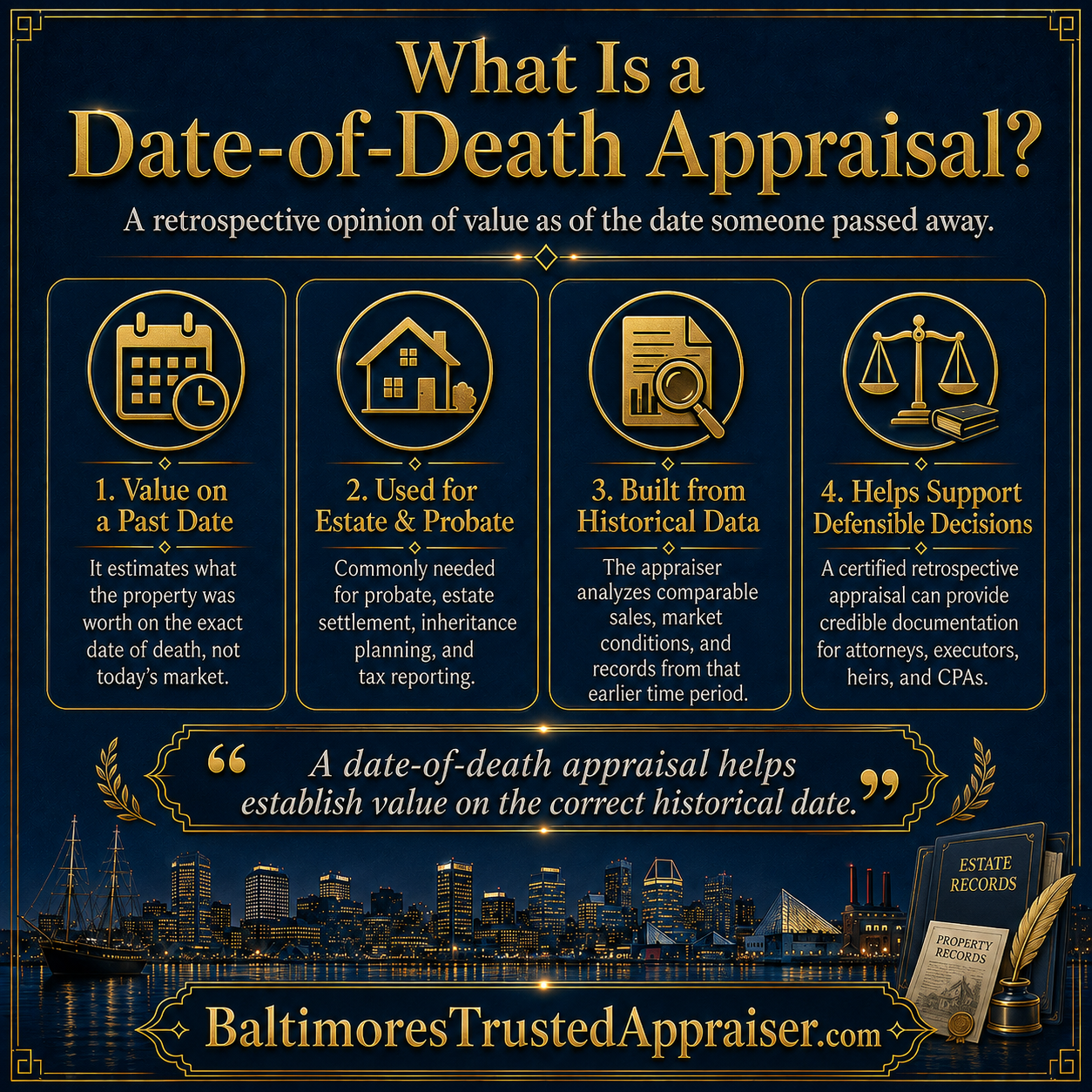
A date-of-death appraisal (also called a retrospective appraisal) determines a property's fair market value as of a specific past date — the decedent's date of death. The effective date of value is historical, even though the inspection and report happen now. This is what the IRS, the Maryland Orphans' Court, and estate attorneys require to settle an estate correctly.
It is fundamentally different from a current-value appraisal. The appraiser must set aside everything that has happened to the market since that date and value the property strictly on the conditions, comparable sales, and neighborhood dynamics that existed then.
Why "Even Years Later" Isn't a Problem
Executors often don't order the appraisal right away. Estates take time. Grief, sibling coordination, and probate delays mean the request frequently comes months or years after the death. Families worry the window has closed.
It hasn't. A retrospective valuation is reconstructed from historical evidence, not present-day observation:
Historical MLS and closed-sale archives for the specific date range and micro-market
Public records documenting the property's condition and characteristics as of that period
Neighborhood-level market data capturing what buyers actually paid on that block at that time
My own continuous records since 1989, which cover Baltimore's market through multiple cycles — including the 2008 downturn and the recovery years that AVMs and out-of-area appraisers routinely misread
The further back the date, the more this depends on genuine historical depth. Zillow and Redfin cannot produce a defensible retrospective figure — they model today, not 2011 or 2003.
Why USPAP Compliance Matters Here
A retrospective appraisal must be USPAP-compliant to be accepted by the IRS (for Form 706 estate tax and stepped-up basis) and by Maryland probate authorities. That means a defensible methodology, clearly documented comparable selection, and a report that a court or auditor can scrutinize line by line. A real estate agent's CMA does not meet this standard and can be rejected — an expensive lesson to learn during an audit or an heir dispute.
Baltimore-Specific Factors That Change the Number
Reconstructing a Baltimore valuation isn't just about pulling old comps. Local encumbrances materially affect fair market value, and they existed on the date of death too:
Ground rent — leasehold vs. fee simple status changes value and must be handled correctly
CHAP historic districts — historic designations carry both restrictions and tax-credit implications
Block-by-block swings — value can shift dramatically within a few streets in neighborhoods like Canton, Federal Hill, and Roland Park
An appraiser without deep local history will miss these. That's where 36 years on the ground matters.
Go Deeper With the Free Estate & Probate Guide
If you're navigating an estate and want the complete picture, I've published a free Baltimore Estate & Probate Appraisal Guide that walks through everything in plain English — the exact IRS qualified-appraiser requirements, the 60-day and 9-month Form 706 timing rules, a worked stepped-up basis example showing real capital gains savings, a 5-step process for ordering an estate appraisal, and answers to the questions executors and attorneys ask most. It's built for families, executors, and the estate attorneys and CPAs who advise them. It's a strong companion to this article and costs nothing to read.
How to Get Started
If you're an executor, heir, or estate attorney who needs a date-of-death valuation — recent or years past — you can reach me directly:
Ed Drost, Residential Appraisal Solutions, LLC
Baltimore's Trusted Appraiser
Ed Drost is a Maryland State Certified Residential Appraiser (License #30004874) and the founder of Residential Appraisal Solutions, LLC, known across the region as Baltimore's Trusted Appraiser. He has been appraising real estate in Baltimore City, Baltimore County, and Harford County since September 1989 — more than 36 years — with a focus on estate, probate, date-of-death, and stepped-up basis appraisals. Ed provides USPAP-compliant, IRS- and court-ready valuations and is available as an expert witness in Maryland Orphans' Court. He is also an AI Visibility Architect, helping professionals build authority and get found in the age of AI search.
📞 443-904-5229
Experience builds value. AI builds leverage.
- Aug 24
How to Get a Retrospective Date-of-Death Appraisal in Baltimore (Even Years Later)
- Ed Drost
- Baltimore's Trusted Appraiser
- 0 comments