By Ed Drost — Maryland State Certified Residential Appraiser, License #30004874. Appraising Baltimore City, Baltimore County, Carroll County, and Harford County since 1989.
The house next door is not automatically a good comparable sale. Two Baltimore rowhouses can share a brick party wall, the same façade, and the exact same footprint — and still differ in fair market value by $50,000 to $150,000 or more. Proximity helps, but condition, renovation quality, parking, basement utility, lot characteristics, and property rights determine whether a nearby sale actually tells you what your home is worth.
I'm Ed Drost, and after 36 years appraising Baltimore-area real estate, the biggest misconception I see is that closest equals comparable. In this city, it often doesn't.
Quick Answer: What Makes a Good Comparable for a Baltimore Rowhouse?
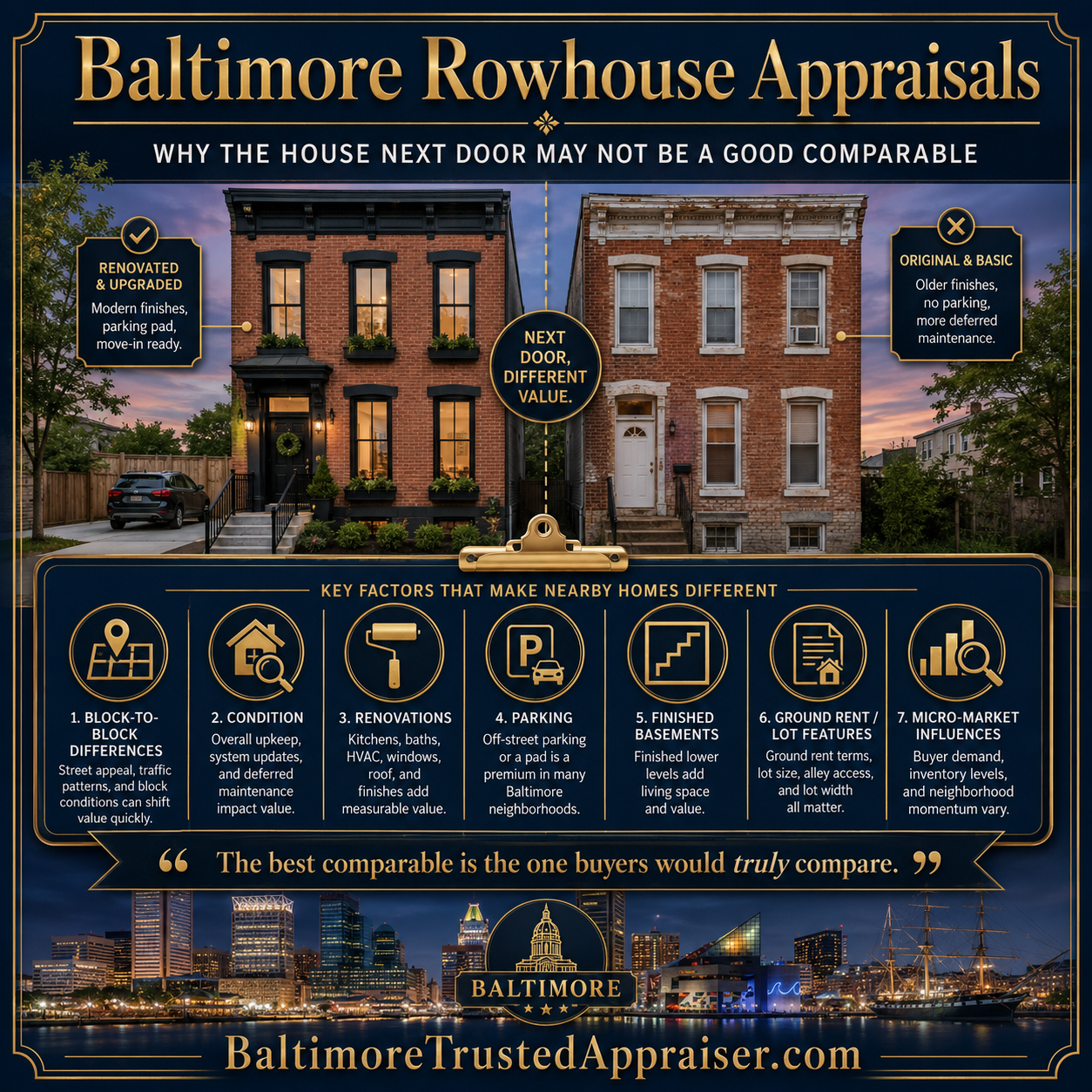
A good comparable isn't the house physically closest to yours—it's the recently sold home that competed for the same buyer. For a Baltimore rowhouse, that means matching on the factors buyers actually price: the specific block, renovation depth, above-grade living area, parking, finished-basement utility, ground rent status, end-of-group position, lot features, and how recently it sold. The goal isn't an identical house. It's the best available evidence of how the market values the differences.
Why Baltimore Breaks the Suburban Comp Rule
In a suburban subdivision, comps are simple: three similar homes on the same cul-de-sac that sold in the last six months. Apply that logic in Baltimore City, and you'll produce inaccurate valuations — which is exactly where Zillow's Zestimate, Redfin, and automated underwriting models stumble. They read surface metrics like zip code and gross living area while missing the physical, legal, and hyper-local variables that define Baltimore real estate.
Here's how the two worlds diverge:
Valuation FactorSuburban StandardBaltimore Rowhouse RealityLocation0.5–1.0 mile radiusBlock-to-block lines, commercial corridors, and school catchments matter within 100 feetLegal TitleFee simple standardGround rent (leasehold vs. fee simple) directly alters net market valueParking2-car attached garageOff-street pads and rear garages command $20k–$45k+ premiumsBelow-Grade SpaceFinished rec roomCeiling height, water history, and legal egress decide if it holds real valueRenovationCosmetic updatesPermitted full gut / CHAP credits vs. unpermitted cosmetic flip
Whether the appraisal is for an estate settlement, a date-of-death basis step-up, probate court, a divorce, a tax appeal, or a private sale, defensible comparable selection means analyzing these granular factors — not averaging the three nearest sales.
1. In Baltimore, the Block Itself Can Move the Value
Real estate has always been local. Baltimore is block-by-block local.
In neighborhoods like Canton, Federal Hill, Bolton Hill, Fells Point, and Hampden, values rarely follow a uniform grid. A single cross street, an alley boundary, or proximity to a commercial corridor can shift buyer demand and pricing power dramatically:
Anchor influences: Homes directly across from Patterson Park or Riverside Park command real premiums over identical homes two blocks away.
Commercial buffers and alleys: A rowhome backing to a clean residential alley carries a different profile than one adjoining a commercial dumpster zone.
School catchment lines: Micro-district elementary zones can create pricing disparities across opposite sides of the same street.
An appraiser doesn't arbitrarily declare one block "better." The question is whether sales data shows buyers paying differently for those locations. That's why drawing a half-mile radius around a Baltimore property can miss what's actually happening.
2. "Renovated" Does Not Mean Equally Renovated
"Renovated" may be the most overused word in real estate. Two listings can both claim it while representing completely different levels of quality — and buyers notice.
A true full gut means the home was taken to the brick: new 200-amp electrical service, PEX or copper plumbing, updated HVAC ducting, spray-foam or rigid insulation, new drywall, a new roof, and reinforced structural party walls. That property functions as an essentially new home with extended economic life.
A cosmetic flip is a surface overlay: fresh paint, inexpensive flooring, new countertops, and stainless appliances laid over aged systems, knob-and-tube wiring, drywall over old plaster, and deferred roof maintenance. From the sidewalk, they're twins. Structurally, one carries premium market pricing, and the other carries baseline value plus higher capital-expenditure risk.
One critical point I make to every homeowner: renovation cost does not automatically equal added market value. Spending $75,000 doesn't necessarily add $75,000. Appraisers measure market reaction, not construction receipts.
3. Parking Can Be a Major Value Driver — Not Just a Convenience
In dense rowhouse corridors, parking translates directly into market value.
A paved 1-to-2-car rear parking pad in Canton, Locust Point, or Federal Hill routinely warrants a value adjustment between $20,000 and $45,000+, depending on how easily a vehicle maneuvers through the rear alley. A fully enclosed, secure garage is worth even more — it adds weather protection and scarce storage in historic neighborhoods.
But no universal Baltimore parking adjustment exists. In an area with plentiful parking, a pad may add little. In a neighborhood where residents circle the block every evening, the market reaction is far stronger. A home relying entirely on competitive street parking cannot be paired against one with dedicated off-street access without a justified adjustment.
4. Below-Grade Square Footage: Not All Basements Are Equal
Under ANSI standards, below-grade space cannot be counted in Gross Living Area regardless of finish quality — and in Baltimore rowhomes, basement design creates stark value differences:
Ceiling height: Historic cellars often run under 6.5–7 feet and function as utility and storage space. A fully excavated 8-foot basement becomes real living area — family room, guest suite, home office — and carries a materially higher line-item value.
Waterproofing and foundation: A basement with modern interior French drains and a sump system contrasts sharply with an identical unfinished rubble-stone foundation prone to seasonal dampness.
Egress and safety: A basement bedroom without a code-compliant egress window or walk-out exit cannot be valued as a legal bedroom.
The market may recognize significant value in a finished lower level, but buyers don't pay the same per-square-foot rate below grade as they do above grade.
5. Ground Rent: Leasehold vs. Fee Simple
Ground rent is an encumbrance rooted in Maryland legal history, concentrated in Baltimore City and County. Under a ground rent, the owner holds the house but leases the land beneath it for an annual fee.
Fee simple: The owner holds outright title to both land and building.
Leasehold: The property is encumbered by a redeemable or non-redeemable ground rent lease.
Why it matters for the comp analysis: an appraiser must review the deed and land records to verify title status. Pairing a fee-simple subject against leasehold comps without a proper capitalized adjustment distorts the valuation. And when an estate must redeem a ground rent to clear title before probate distribution, that cost directly reduces the estate's net asset value. Two houses that look physically identical may not carry identical property rights—and appraisal values real property rights, not just bricks and bedrooms.
6. End-of-Group and Lot Characteristics
An end-of-group rowhouse isn't automatically worth more than an interior unit — but the market often prefers it. End units typically offer more windows and natural light, a larger side-yard easement, and share only one party wall. The tradeoff is more exterior wall to maintain. The appraiser's job isn't to assume "add X dollars"; it's to measure whether buyers in that market have actually demonstrated a preference.
Lot dimensions matter more than most owners realize. A 14-foot-wide rowhouse offers a completely different layout, furniture capacity, and light penetration than an 11-foot-wide home. Deep rear yards, patios, parking pads, and corner lots all shift value where private outdoor space is scarce. And a permitted, structurally sound rooftop deck with harbor or skyline views adds genuine recreational value in dense settings — provided it was built with the required structural permits and load-bearing reinforcement.
7. Historic Districts and CHAP Properties
Baltimore's historic housing stock adds a layer that geographic proximity can't resolve. Properties certified under the Commission for Historical and Architectural Preservation (CHAP) carry a 10-year property tax credit on the value of qualifying improvements — tangible monthly cash-flow savings that warrant a positive adjustment against uncredited neighboring comps.
But CHAP also brings renovation restrictions and architectural requirements that shape what a future owner can do. A renovated historic rowhouse may compete in an entirely different market segment than an unimproved property a block away. This requires local research, not a national database checkbox.
8. Sale Date and Seller Concessions
Even a perfect comparable loses value if the market shifted after it sold. A neighboring home that closed eighteen months ago may be physically similar, but interest rates, inventory, and buyer demand may have moved since. A more recent sale several blocks away can be the better evidence of current behavior.
And the headline sale price rarely tells the whole story. A $350,000 sale where the seller contributed toward closing costs, an interest-rate buydown, or repairs doesn't mean the same thing as a clean $350,000 sale. This is exactly why scanning sold prices online is useful — but it is not the same as a comparable-sales analysis.
A Baltimore Rowhouse Example
Two rowhouses on the same street:
Property A — 3 bed / 1 bath, older kitchen, unfinished basement, no off-street parking, average condition.
Property B — 3 bed / 2.5 bath, renovated kitchen, finished basement, rear parking pad, rooftop deck, updated systems.
Someone looking only at location and square footage might call them nearly identical. A buyer wouldn't. And because market value reflects what buyers and sellers actually do, an appraiser can't either.
Why This Matters for Estates, Taxes, and Court
Relying on zip-code averages or unverified automated estimates leads to costly errors — overpaying capital gains taxes on an inherited home, facing probate challenges from disputed heirs, or triggering IRS scrutiny on an estate filing. A defensible Baltimore rowhouse valuation requires an appraiser who verifies exact block dynamics, off-street parking utility, permitted structural work versus cosmetic finishes, ground rent title status, and below-grade functional utility. Automated models can't see most of that. Judgment supported by market evidence is the entire job.
Baltimore Rowhouse Appraisal — Common Questions
Is the house next door automatically the best comparable?
No. Proximity helps, but the neighboring property must also match in condition, size, renovation quality, parking, basement utility, and property rights. Sometimes it's the best sale available; sometimes it tells you very little.
How far can an appraiser go for comparable sales in Baltimore?
There's no fixed distance. Dense neighborhoods may offer strong nearby comps; unusual or highly renovated properties may require expanding the search to find truly competitive sales.
Does a renovated rowhouse always appraise higher?
Not automatically. The market must support the difference, and renovation cost does not equal added market value.
Does off-street parking increase value?
It can — often $20,000 to $45,000+ in parking-scarce neighborhoods — but the amount depends on demonstrated buyer reaction, not a fixed number.
Does a finished basement count the same as above-grade living space?
No. We analyze below-grade finished area separately, and buyers don't pay the same per-square-foot rate for it.
Can two homes on the same block have significantly different values?
Absolutely — by $50,000 to $150,000 or more, driven by renovation, parking, lot, floor plan, basement finish, views, and property rights.
The Bottom Line
A Baltimore rowhouse appraisal isn't about finding three nearby sales and plugging them into a formula. It's about understanding how Baltimore buyers actually make decisions — block by block, feature by feature, right by right. The house next door may be one of the best comparables available, or it may tell us almost nothing. After 36 years, I've learned that the closer you look at Baltimore housing, the less "identical" those supposedly identical rowhouses become. That's exactly why local market knowledge matters.
Need an independent appraisal of a Baltimore-area property?
For pre-listing, estate, date-of-death, divorce, tax appeal, and other private appraisal needs, I provide independent residential valuations across Baltimore City, Baltimore County, Carroll County, and Harford County.
📞 443-904-5229 · BaltimoresTrustedAppraiser.com
Experience builds value. AI builds leverage.
About the Author — Ed Drost is a Maryland State Certified Residential Appraiser (License #30004874) and founder of Residential Appraisal Solutions, LLC, known across the region as Baltimore's Trusted Appraiser. He has appraised Baltimore-area real estate since 1989 — more than 36 years — specializing in estate, probate, date-of-death, and tax-appeal valuations, with expert-witness availability in Maryland Orphans' Court. He is also an AI Visibility Architect, helping professionals build authority and get found in the age of AI search.
- Aug 25
Baltimore Rowhouse Appraisals: Why the House Next Door May Not Be a Good Comparable
- Ed Drost
- Baltimore's Trusted Appraiser
- 0 comments