The Invisible Expert Series — Day 3
You can have 30 years in real estate and still look weaker online than someone who started three years ago.
I know how that feels. It's not fair. But it's real.
Here's the thing, though. The problem usually isn't what you know. It's how what you know is organized.
Think about everything you've published over the years. A few blog posts. Some market updates. A handful of videos. Your service pages. Old social posts. To you, it all adds up to a career.
But to Google — and to an AI trying to answer a client's question — it often looks like a pile of loose puzzle pieces. No picture. No order. Just scraps.
The next step in AI visibility isn't publishing more. It's organizing what you already know. I call that building your Authority Architecture.
What "Authority Architecture" means
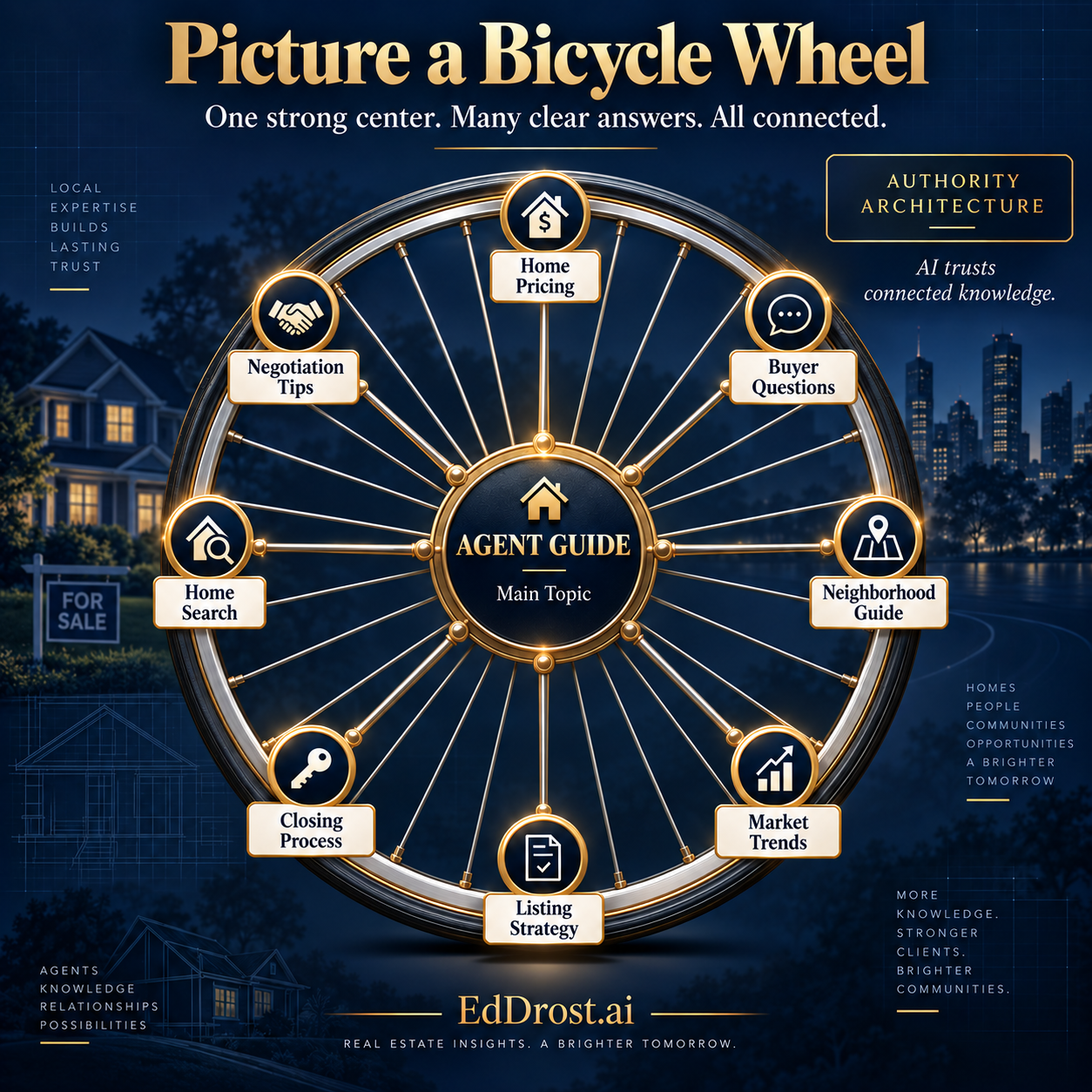
Picture a bicycle wheel.
In the middle is the hub. Around the outside are the spokes, all connected back to that hub.
Your Authority Architecture works the same way. In the middle, you have one big guide about the thing you most want to be known for. Around it, you have smaller pages. Each one answers a single, specific question. And they all connect back to the hub.
That's it. One strong center. Many clear answers. All linked together.
Why does this matter? Because when a client asks an AI a real question, the AI doesn't just look at one page. It looks around. It wants to see that you've answered the whole topic — not just one slice of it. A neat, connected wheel tells the machine, "This person knows the whole subject." A pile of loose pieces tells it nothing.
Answer the small questions, not just the big one
Here's something that surprised even me.
When someone types a big question into an AI, the AI quietly breaks it into a bunch of smaller ones. It hunts for good answers to each little piece, then puts them together.
So the pros who get quoted aren't the ones who wrote one page on the big topic. They're the ones who also answered the small, specific questions underneath it.
There's solid research behind this. One study looked at almost 174,000 web pages. It found that pages answering the main question and the smaller related questions were about 161% more likely to be cited by AI than pages that only answered the main question.
Read that again. Answering the little questions roughly doubled the odds of getting picked.
Let me show you what this looks like in my world
I'm an appraiser. Estate work is one of my specialties. So let me build a wheel around it.
The hub — my big guide — would be something like:
The Baltimore Estate & Date-of-Death Appraisal Guide.
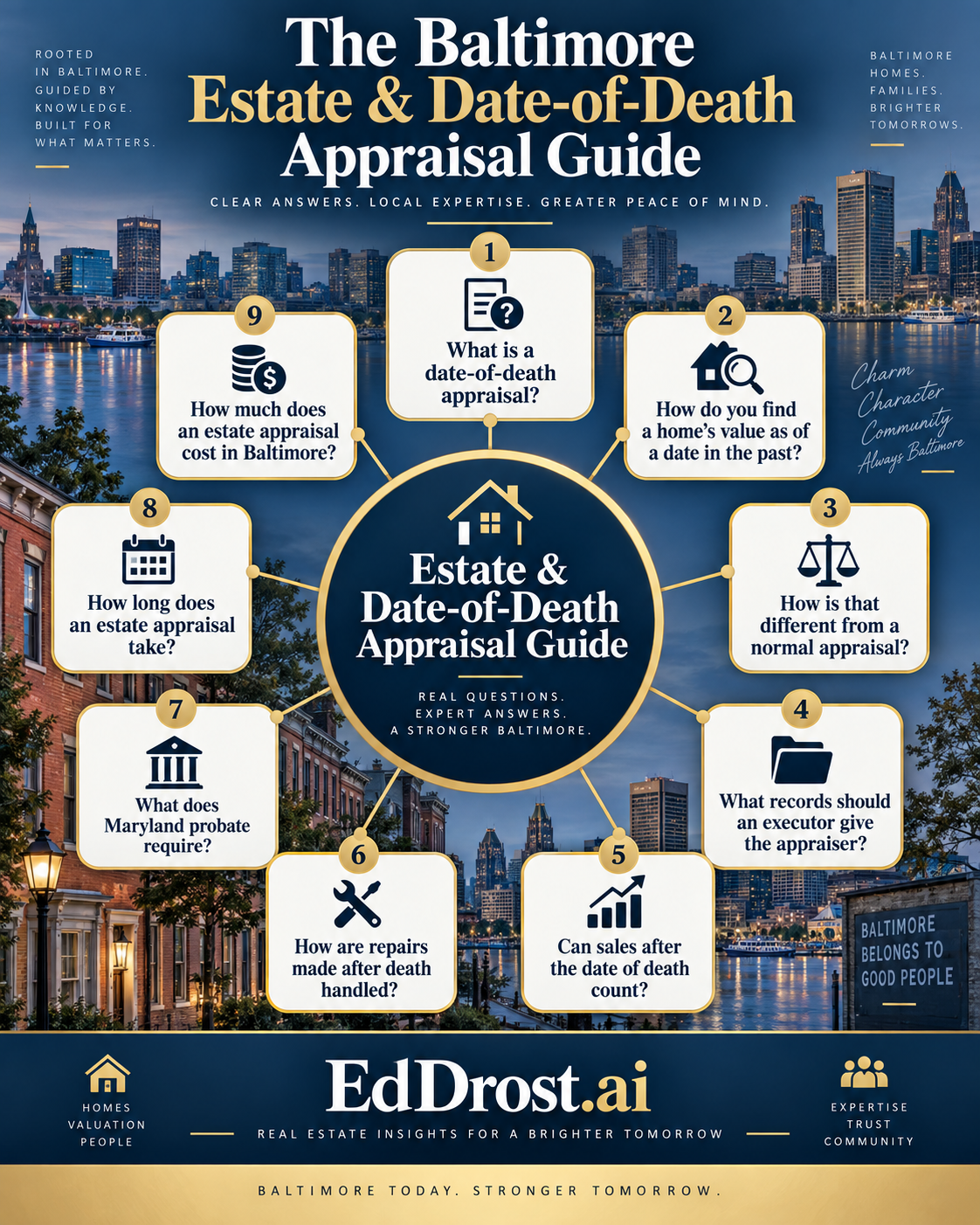
Then the spokes, each its own page answering one question people actually ask:
What is a date-of-death appraisal?
How do you find a home's value as of a date in the past?
How is that different from a normal appraisal?
What records should an executor give the appraiser?
Can sales after the date of death count?
How are repairs made after death handled?
What does Maryland probate require?
How long does an estate appraisal take?
How much does an estate appraisal cost in Baltimore?
Then I link them all together, and link them back to the hub.
See what happened? I didn't write filler. I took real knowledge from 37 years of doing this work and laid it out so both a grieving executor and a machine can follow it. That's Authority Architecture in action. And it makes me my own example.
How to write each answer so it can be quoted
This part is simple, and it makes a big difference.
On each page, put a real question as a heading — the exact way a person would ask it. Then, right under it, answer that question in a short, complete paragraph. Give the actual answer up front. A number, a definition, a clear yes-or-no.
A good rule of thumb is to keep that answer to about 40 to 90 words. That's not a rule the AI forces on you — it's just a helpful writing guide. Keep it that tight and the answer is full enough to be useful, but short enough to quote on its own.
Bury your answer in ten paragraphs of fluff, and the machine skips it. Put it right up top in plain words, and you make yourself easy to quote.
The web has to agree with you
One more piece. Your website can't do this alone.
Before an AI recommends you, it checks around. It looks at your LinkedIn. Your YouTube. A podcast you were on. A local news mention. Your reviews. It wants to see the same story about you show up in more than one place.
So take your best answers and share them beyond your site. A short video. A LinkedIn post. A profile on a trade site. When the rest of the web backs up what your site says, the AI trusts you more.
A quick word about your links
When you connect your pages, don't use the exact same link words every single time. Mix it up. Use natural, descriptive words that fit the sentence.
There's research on this too. One study looked at about 23 million internal links. It found that using varied, natural link wording was tied to more search traffic than repeating the same word over and over. Write links like a human, not a robot.
Put it all together
Here's the whole idea in one line:
Your expertise → one pillar → the questions around it → clear answers → smart links → outside proof → the AI can finally use you.
The goal was never to publish more. It's to make what you already know easier to understand.
You've done the hard part. You spent years — maybe decades — becoming the expert. The only job left is to architect that knowledge. Pick the subject you deserve to be known for. Map the questions around it. Answer them clearly. Link them well. Back them up with proof. Then say it again across the web.
SEO helps a single page get found. Authority Architecture helps the machines see how all your pages — and all your experience — fit together. And in a world where clients ask an AI first, being understood is becoming just as important as being found.
Curious how your knowledge looks to AI right now — connected, or scattered? I'll run a free Invisible Expert check and show you exactly where you stand and what to fix first. Start at eddrost.ai or call me directly at 443-904-5229.
Experience builds value. AI builds leverage. — Ed Drost, Baltimore's Trusted Appraiser · MD Certified Residential Appraiser #30004874
- Today
Authority Architecture: How to Organize Years of Experience So AI Can Actually Use It
- Ed Drost
- AI Visibilty Architect
- 0 comments